Living in Aachen: Ancient Capital at the heart of Europe

Introducing Aachen:

Over a year ago, I moved from Edinburgh to the City of Aachen located in the “Euregio” on the border of Germany, Holland and Belgium.  Living in Germany’s most Westerly City has given me a great opportunity to learn about the history, diversity and culture  of  this ancient capital and how European integration is starting to erode the significance of  national boundaries in a remarkable corner of Europe.

Visitors to Aachen are often pleasantly surprised by this diverse and welcoming University City with a fascinating history which stretches back to the Roman times and beyond. 

Aachen: an international city at the heart of Europe

A bit of history:

Aachen was first favoured by the Romans for its hot mineral springs which offered welcome relief from the more turbulent lands East of the Rhine which were a source of bitter conflict with Germanic tribes. The City is best known, however, as being the favoured haunt of Charlemagne, the Dark Age King who, in 748AD became the first Emperor of the Holy Roman Empire, a vast area of territory which covered much of Western Europe including much of modern-day France and German. Like the Romans, Charlemagne, also enjoyed lounging around in hot baths and decided to establish Aachen as the capital of his Dark Age Carolingian Empire.

Charlemagne is seen as the person who first set in place the foundations for modern-day Europe, although at the time his expansionist policies and uncompromising approach gave him somewhat controversal reputation.  Amongst Charlemagne’s greatest achievements were the establishment of  his palace complex in Aachen, which includes the fabulous and unique Aachen Cathedral (Aachener Dom) established between 793AD and 813AD.  The site of the present day Town Hall (or Rathaus) was also part of the palace complex and formed Charlemagne’s residence and seat of power.

Charlemagne’s octagonal Dom forms the backdrop to Aachen’s historic centre

Remarkably the Cathedral’s central octagonal dome built by Charlemagne (at one time the highest construction North of the Alps) has survived completely in tact since the Dark Ages. Over the centuries it has been added to considerably with additional chapels and new wings added. In 814AD the Aachen Dom became the burial-place of Charlemagne and then later the coronation place of German Kings. It also retains some remarkable and unique religious relics and is a centre of pilgrimage.

The Old Town of Aachen:

Although much of Aachen was destroyed, first by a great fire in 1656 and then during WWII, the City has managed to preserve much of the history and atmosphere of its historic centre (or “Altstadt”) with winding closes, squares and alleyways packed with history and charm. In this respect visiting Aachen is a real pleasure with many unique and intimate spaces to explore.

The winding streets of the Altstadt are made substantially more colourful by a multiplicity of street cafes, open air markets and street entertainers. In short there is always something interesting to look out for around every street corner.

The Aachener Altstadt: the colourful closes and pedestrianised streets are a delight to explore on foot

Street Markets and independent shops:

Aachen’s street markets are diverse and colourful affairs and serve a much more important role than merely providing a point of interest to tourists. The markets supply a range of fresh, seasonal and often locally produced products ranging from fruit and vegetables through to  speciality cheeses and meat.  Whilst not always the cheapest, prices in the market do compare favourably with supermarket prices and with the obvious advantage of better quality.

Fresh fruit and vegetables from the street market

This contrasts markedly from the more bland retail experience that I am used to back in Scotland where it seems 99% of food shopping is conducted in supermarkets. Unlike farmer’s markets in Britain, Aachen street markets form an important part of the everyday shopping experience. Close to where we live, 3 or 4 markets are held regularly on a weekly basis. Of course, Germans (as the inventors of Aldi and Lidl) obviously make use of cheap supermarkets for basic shopping requirements. However they also tend to stock up on fresher produce from local markets. In general, diets are healthier and there is much less culture of “ready meals” than in the UK.

One of the pleasures of  exploring Aachen is that there is generally a greater range of smaller independent shops of a kind which are rapidly becoming a memory in more corporately minded Britain. This includes specialist stores such as bookshops, delis, fashion and craft shops. The survival of these small businesses in Aachen perhaps results from more conservative German shopping habits and also from less aggressive policies favouring out-of-town development which have been pursued with vigour in the UK. 

Street markets in Aachen; part of the everyday shopping experience

Aachen, however, is not immune from problems. Recently, moves to create a large shopping mall at the Kaiserplatz (in a slightly run down part of the City) resulted in the appearance of a large gap site which has now existed for a couple of years;  apparently the developer ran out of finance for the project.  From what I understand, another developer is now taking things forward and construction will go ahead.

Street sculpture has a strong presence in Aachen: often on a watery theme or on local legends

In the meantime all sorts of interesting ideas had been suggested for the site including urban gardens and community food growing projects (as found on gap sites in Berlin). There is a need for planners to be careful in Aachen not to make the same mistakes as in the UK where city centres, over the last 2 decades, have been becoming increasingly homogenized with a  predictable array of uninspiring chain stores.

Getting around in Aachen:

The pedestrianized streets of the Altstadt are a pleasure to walk around. Despite this Aachen is not without its traffic issues, symptomatic of the fact that the average German is quite simply addicted to their car. Inner and outer ring roads around Aachen are frequently clogged up and drivers can, on occasion, become somewhat impatient (compared with their generally more mellow Scottish counterparts). Germany does however cater for alternative forms of transport better than in the UK with excellent bus services and a generally high provision of paths for walking and cycling.

Biking to kindergarten: children start cycling at an earlier age in Germany than in the UK

Although Aachen still has a long way to catch up with well known”green” cities such as Munster and Freiburg in terms of offering sustainable transport opportunities, many more trips are made by bike than would be the case in a comparable UK city. Cycle lanes are generally safer and are often off-road. As a consequence children start using bikes at an earlier age to get to kindergarten and primary school. You can also see a far greater number of parents transporting children with bike seats and tow along trailers which are still a rarity in Scottish towns.

City of Doctors and Engineers:

German towns have a tendency to specialise and Aachen is no exception to this rule. Consequently,  just about everybody you will meet in Aachen is invariably either an engineer or a doctor.  Most of the latter work at the University Klinikum, one of Europe’s largest hospitals and the sort of place that Prince Charles would delight in describing as a “monstrous carbuncle”.

Inspiration for the building was apparently drawn from the creators of the Pompidou Centre in Paris. Whatever the case, the building resembles (rather frighteningly) an industrial plant or petrochemical complex reminiscent of the sci-fi movie “Brazil”.  Inside, the Orwellian theme continues with (now slightly faded) day-glow green and bright orange decor throughout.

Best to keep healthy is my advice !  Having said this the standard of health care in Germany is without doubt exceptionally high (as are the sheer number of doctors) and puts the level of investment into the NHS to shame. In Germany, unlike Britain, the problem is not that they want to get you out of hospital quickly but rather that they want to keep you there until every conceivable test has been completed and every possible diagnoses considered.
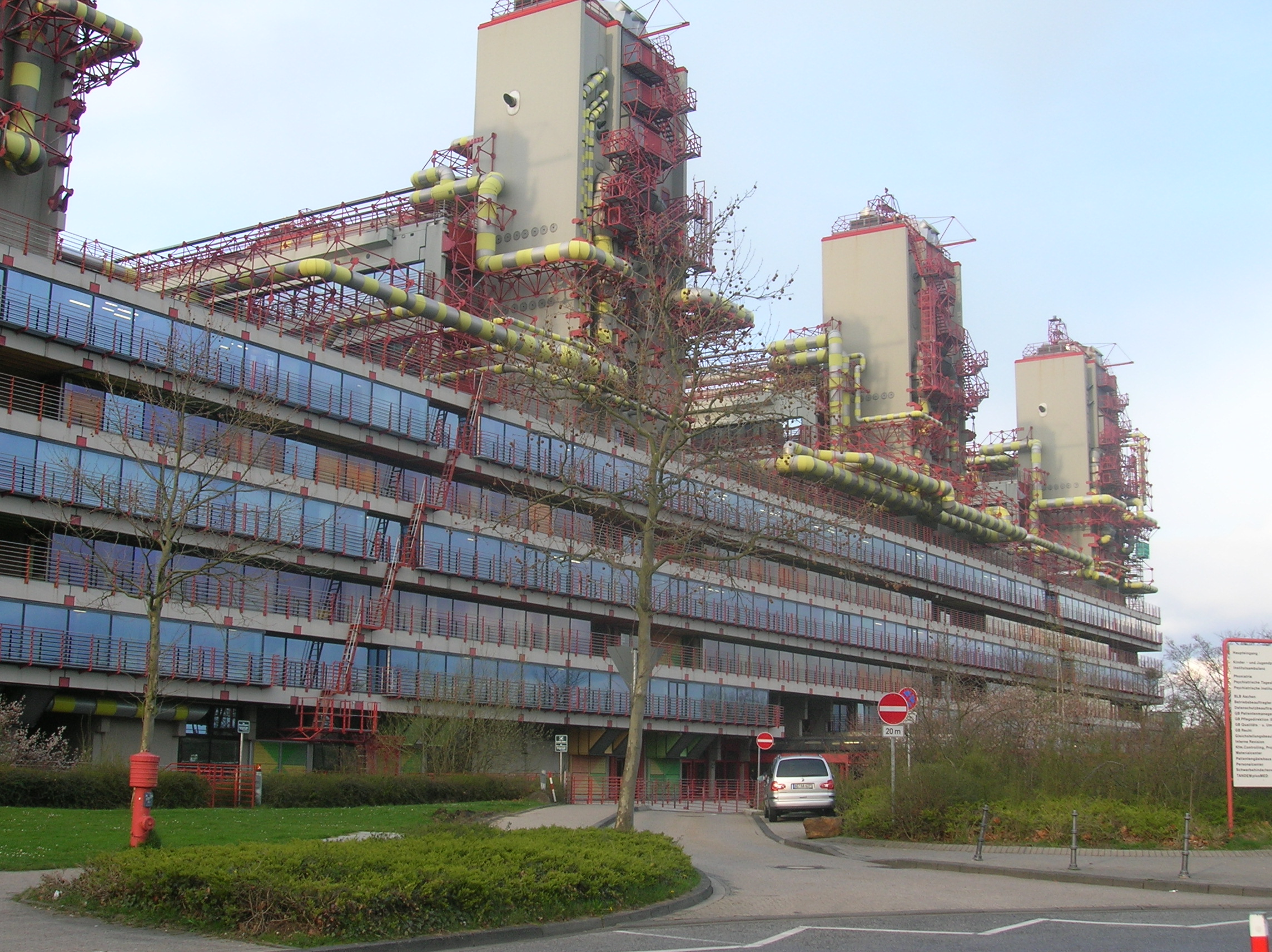
Brave New World: Aachen’s University Hospital – a matter of acquired taste ?

But it is really in engineering and science that Aachen has built its reputation. Whilst less of a manufacturing base than it used to be, the City proudly hosts the RWTH University of Aachen, a renowned University specialising in all matters technical. The streets and bars around the University buzz with student chatter. Fine arts, philosophy or sociology students (or indeed environmentalists like myself) may feel distinctly left out here however as the conversation usually reverberates around the latest “techy” topics such as the solid state hard drive technology or innovation in the world of semi conductors . 

At certain times of the year science takes to the streets with a fascinating  festival held in the City’s main square. Here Aachen’s budding young engineers and scientists showcase their latest technical wizardry to an unsuspecting public complete with flashes, bangs, smoke and pops (Aacheners love a “bang” as anyone who’s been here at New Year and narrowly escaped with their lives will testify). The Science Fair is a great day out for kids. Parents, however,  must have the stamina to cope with a non-stop, ear-splitting assault from student grunge bands who provide the musical backdrop to the event (I must be getting old !).
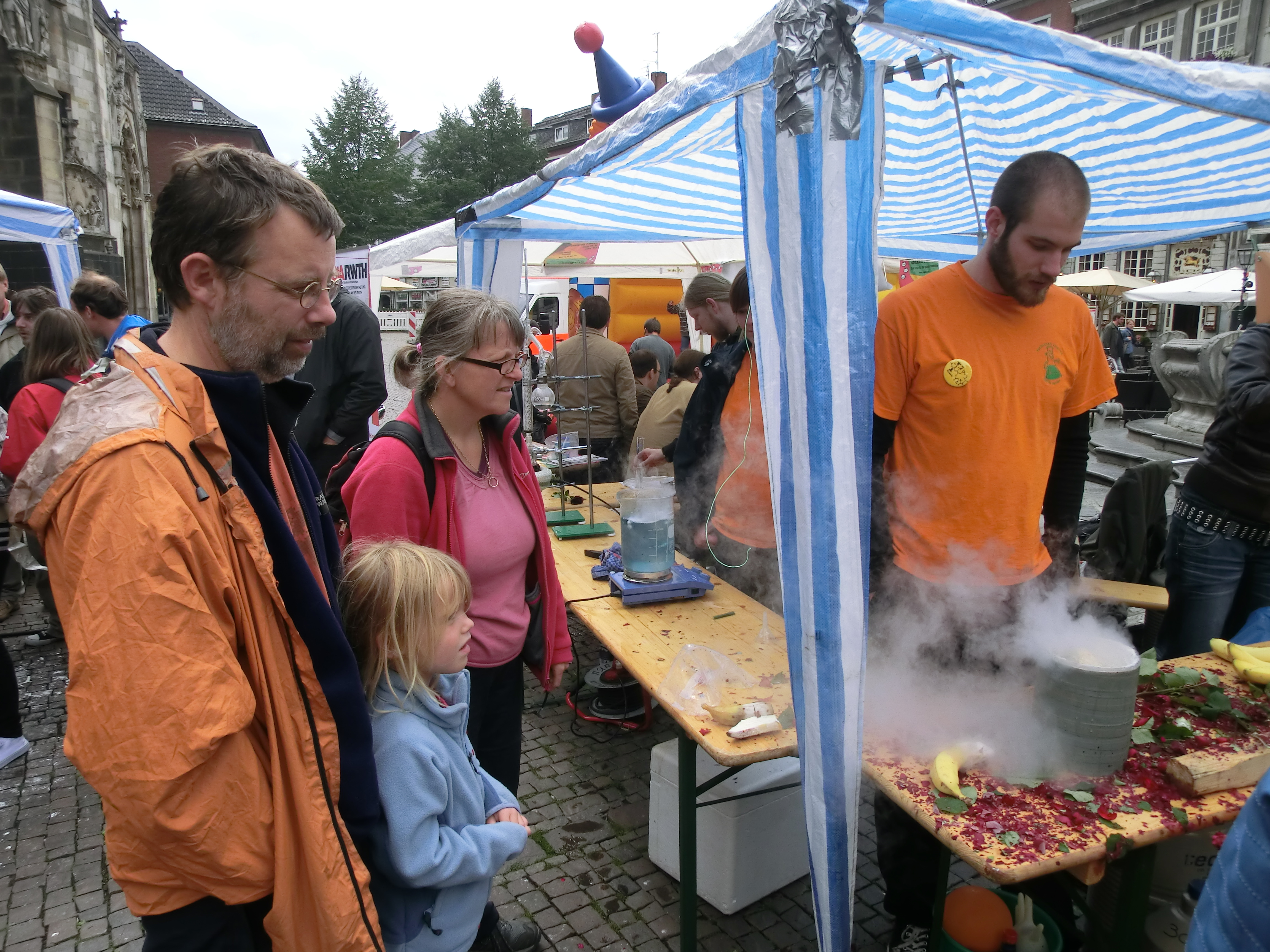
Science on Show: RWTH students and researchers exhibit their wares at a science open day

Escape to the Woods:

If it all gets too much then the Aachener Wald (Aachen Forest), located to the South of the City, provides a superb place to escape to with kilometres of well maintained trails for cycling, walking and horse riding. The Aachen forest is intensively used by the City’s population for all manner of sporting and leisure activities. Even on the wettest winter evening in the forest you will come across large groups of folk determinedly participating in every imaginable pursuit from Tai Chi through to kickboxing.

Nordic Walking is extremely popular at the present time and tends to be practised, more often than not, by more sedate (often overweight and lycra clad) ladies and gentlemen of a certain age.  Mountain bikers on the other hand tend to be “alpha male” type professionals who will automatically expect everyone obstructing their path (OAPs and children alike) to jump clear during each adrenalin fueled descent through the forest.

A good illustration of the more relaxed approach to health and safely in Germany is that you can rent your own pony to take your child on an unsupervised spin around the Aachener Wald with a minimum of fuss. We’ve done this a few times much to the satisfaction of my own kids with only one incident to date when the pony tripped over the reins; my fault for being a little too relaxed about things and not paying attention. As I’ve explored in another article, Germany is much better geared up for getting children out into nature than the UK at present.

Aachener Wald: Outdoor activity opportunities abound

Borders as Bridges:

Aachen’s situation on the border with Belgium and holland provides the city with a unique location within Europe which has been responsible for the rapidly developing significance of the “Euregio” region centred on the three cities of Aachen, Maastricht and Liege.

The past has not always been so positive in terms of relations between the three countries; buried deep in encroaching woodland, behind a housing estate near to the Dutch border lie the remains of the “Westwall”, the old fortified frontier of WWII Germany, now rotting away and partially forgotten amidst the undergrowth.  
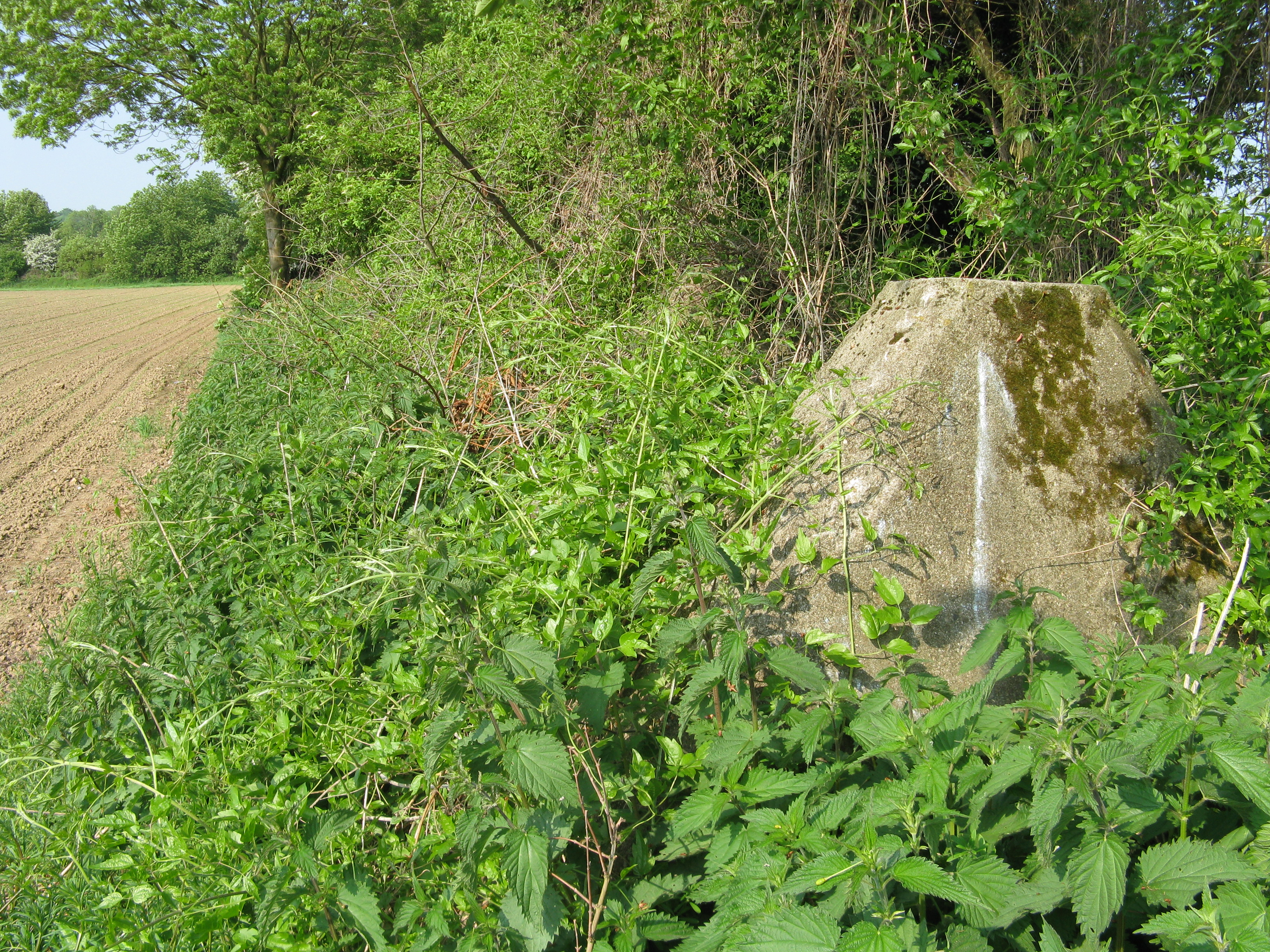
Reminder of darker days: The WWII “Westwall” hidden in the undergrowth behind a suburb west of Aachen.

Fortunately these darker days are now very much in the past. The emphasis is now on integration through co-operation for mutual economic benefit.  You can now move effortlessly between the three countries without so much as the flash of an ID card or passport. Old border check points have now been creatively redeveloped as coffee shops, kiosks or as small art galleries. Indeed many people from Aachen take advantage of cheaper housing in Netherlands or Belgium and commute across the border every day.

It’s always interesting to note the cultural differences between the three countries which often, though not always, confirm to popular stereotypes. The Dutch appear relaxed and more outgoing than the Germans but are, quite surprisingly, tidier and more organised when it comes to designing their living spaces, shopping and transport infrastructure. In Holland everything is neat, well organised and usually somehow relates to opportunities for visiting coffee shops and eateries of various descriptions (which abound in even the smallest of villages).

The province of South Limbourg which adjoins Aachen is, for the Dutch, what the Alps are to the rest of us. Indeed the highest “mountain” in the Netherlands can be found at the Dreilandereck just outside Aachen (all of  a few hundred metres above sea level).  As a result of this, cycling and walking routes in South Limbourg throng with hordes of  holiday makers and ramblers looking to get their  Dutch “mountaineering” fix (or at least as close as you will come to it in Holland).

Just over the border in Belgium, the situation is very different; walk through almost identical countryside and you will meet almost no-one.  Belgium, however, is more chaotic and with a Gallic flair and joie de vivre seldom encountered in Germany (except perhaps during carnival time). This is also expressed negatively however, with a chaotic cluster of  day-glow signage found on most street corners directing you to the nearest furniture warehouse, DIY store  or fast food outlet. Excessive roadside advertising is  indeed the curse of Belgium and detracts from an otherwise often beautiful landscape.
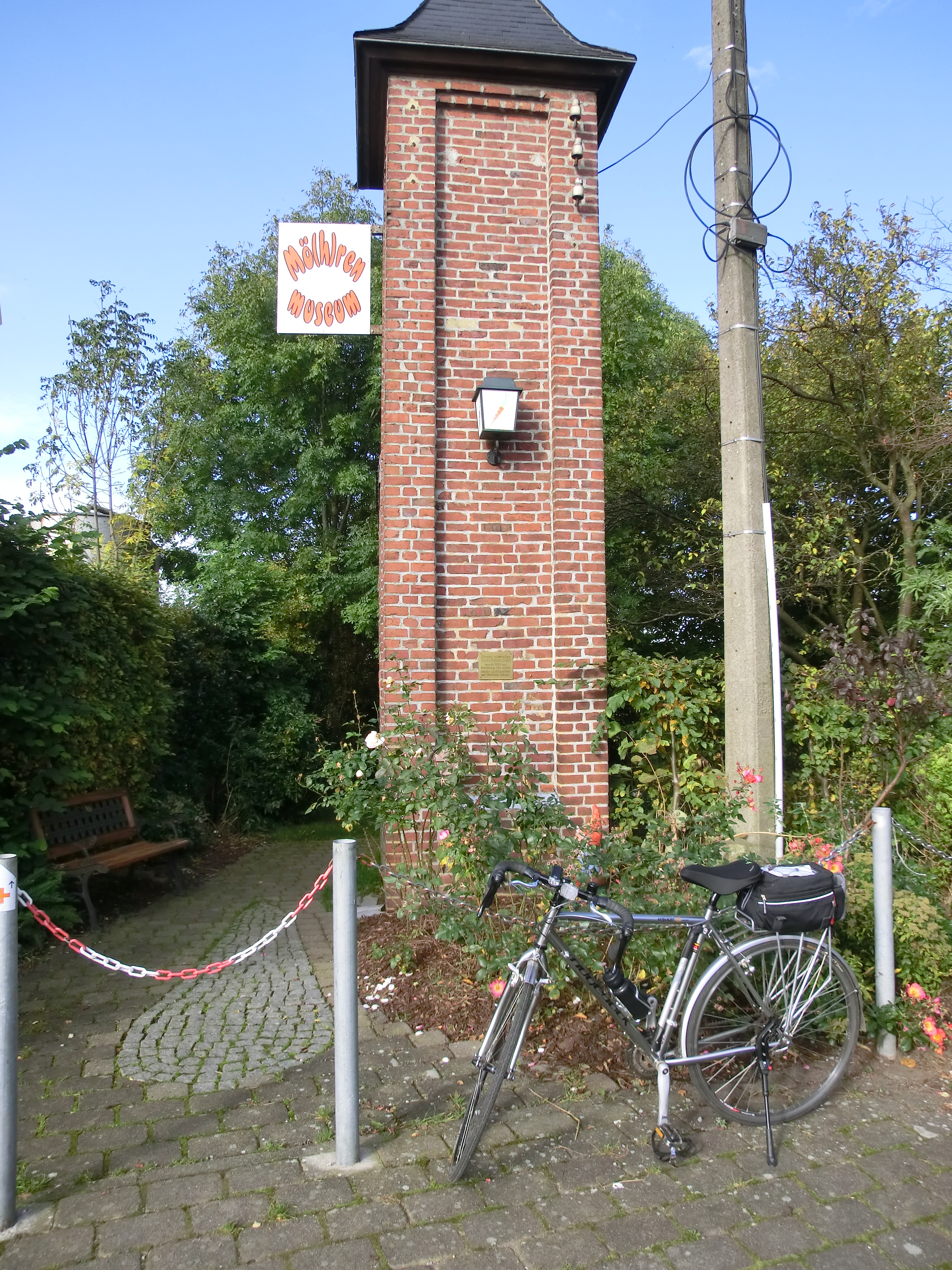
Not to be missed: the World’s smallest carrot museum !

On a positive side Belgium does offer some wonderful eccentricities of a sort seldom found in Germany. The other day for example, whilst out for a bike ride in Belgium, I came across the world’s smallest “carrot museum” which had been constructed from a disused tower in a sleepy rural village. A visit to the carrot museum would certainly not fill up an afternoon’s itinerary but is  an interesting illustration of alternative Belgian thinking. 

The three cities themselves of Aachen, Maastricht and Liege probably are as good an illustration as any of the cultural differences between the three countries.  Geographically the three stand only a few tens of kilometres away from each other but culturally they could be worlds apart.

Round about Aachen – North and South:

North and south of Aachen can be found contrasting landscapes with  former mining and industrial landscapes associated with brown coal deposits to the North and the forested upland plateau of the Eifel rising to the South.

Former industrial centres such as Herzogenrath and Alsdorf were once major centres for mining and are currently in the process of reinventing themselves as they start to cash in on the shared benefits of being in the Euregio which include improved transport links, economic development and shared recreation and leisure facilities.

Even here though, it takes time to change traditional habits of movement and sometimes people will travel further afield rather than use facilities located just over the border  in a neighbouring country (the major exception being IKEA at Heerlen the Netherlands!).  Projects and initiatives such as the Gruenmetropole and the Grenzrouten are helping to create a sense of greater unity through promoting shared aspects of cultural history such as industrial heritage though this will be a long and complex process.
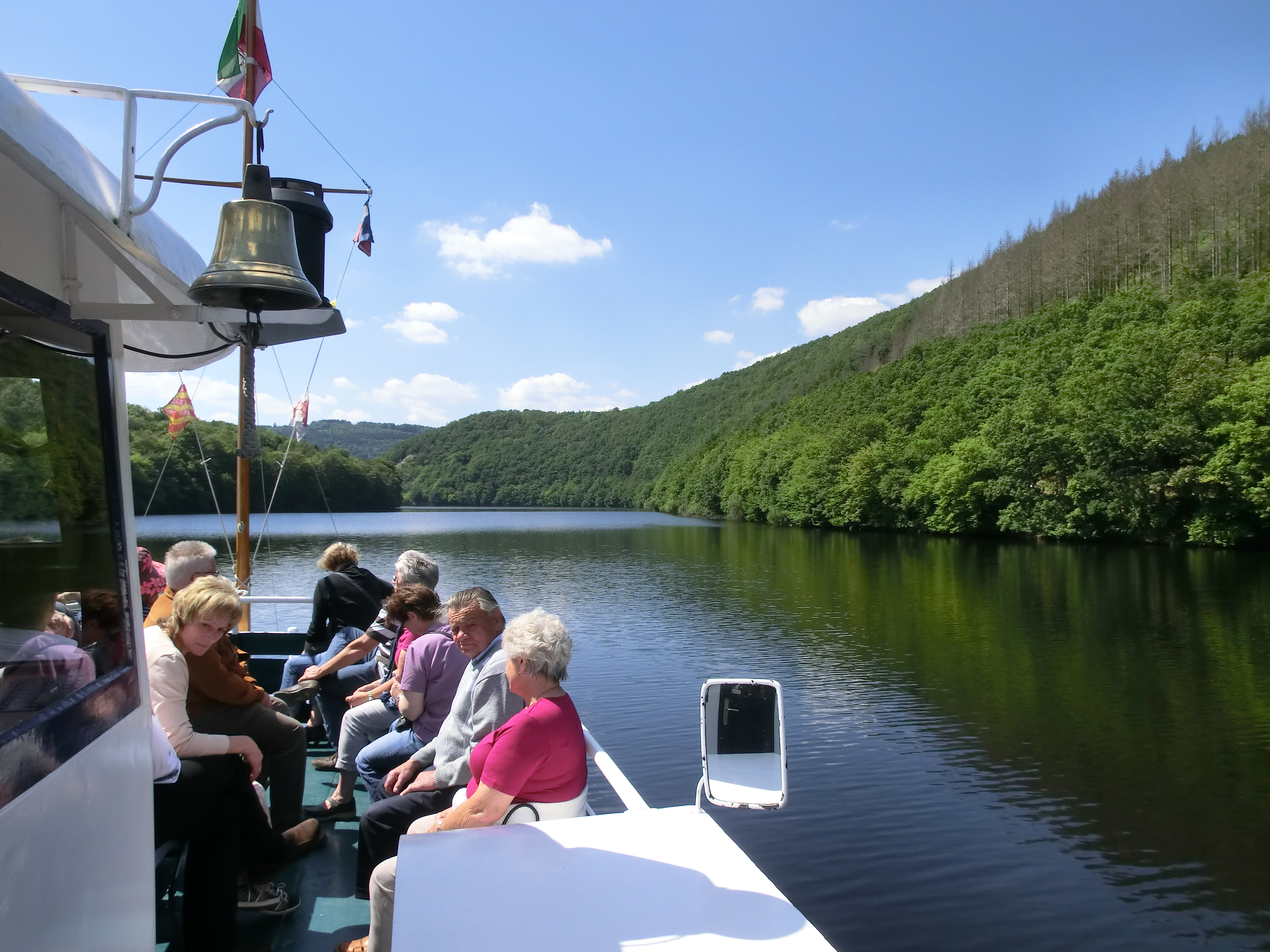
Eifel National Park: a popular place to get out into nature

The Eifel region, South of Aachen, provides a superb recreational resource for the people of the region and stretches for many Kilometres  towards  the Mosel Valley. This area is now easily accessible from Aachen by foot or by bike thanks to new recreational routes such the Vennbahn (a converted tramway) and the Eifelsteig, a long distance walking route linking Aachen with Trier.

In terms of visitor locations the picturesque village of Monshau, the Eifel National Park and the Hohe Venn (an extensive area of regenerating heathland)  are some of the real jewels in the crown within the Eifel Region. All are popular with visitors to Aachen as places for day excursions.

Monschau: historic town full of black and white houses

In summary,  Aachen’s unique location on the border between Belgium, Holland and Germany provides  a great base for exploring this fascinating  region across three countries with their contrasting languages and cultures. The City itself also provides us with insights into European history through its associations with Charlemagne and (the often turbulent) later events which helped to shape the development of modern Europe.

Aachen is certainly an interesting place to live and I’d definately recommend a visit !
Posted in Aachen & Euregio, Current Affairs, History & Culture, In Europe | Tagged , , , , , , , , | 7 Comments

Getting the Children Back into the Woods

 On Nature Deficit Syndrome and how to avoid it:

“I want to climb the mountain with YOU Daddy…”, my 4-year-old daughter Zoe urged determinedly as I  gazed upon the inviting summit of Herzogstand somewhere off in the bluey middle distance and mentally put myself on its summit. I was astounded; for the last 4 years we’d been trying to drag our 2 children outdoors on every possible occasion, often amidst a cacophony of moaning and complaints. However, with this simple request from my daughter, I knew that the old world order was overturned and that we had passed the first major milestone.

I was lucky enough to grow up on the edge of the Scottish Highlands and took the outdoor life completely for granted. We walked, climbed, cycled, sailed, beachcombed and spent endless hours happily playing outside by streams, woods, moors and ponds. Nature really was the ultimate freedom. I want my own children to have these opportunities and to discover the same sense of freedom and independence that I was able to feel as a boy and adolescent growing up in Scotland. I believe this is not only important but essential for development.

Getting kids out in the woods: essential for both parent’s and children’s wellbeing alike

I recently read the “Last Child in the Woods” by American author Richard Louv. In his passionate book, Louv examines how the independence of children has progressively been eroded over the last few decades through a reduction in outdoor play opportunities fueled by concerns over litigation, safety culture and perceived risks such as traffic, “stranger danger” and potential physical injuries. The outcome of this has been to banish a whole generation to their living rooms (often slumped infront of the TV), resulting in what Louv describes as “Nature Deficit Syndrome”; a broad term defining a range of problems including low self esteem, attention deficit hyperactivity disorder, obesity and low emotional intelligence.

This really confirms what we all intuitively know; that somewhere along our journey to progress we have taken a few wrong turnings. Determined that “Nature Deficit Syndrome” should not plague my own children, I have been making a concerted effort to introduce my 2 youngsters to the great outdoors; to the woods and the wild places and to forge a connection with nature from an early age which will give them energy and strength in later life.

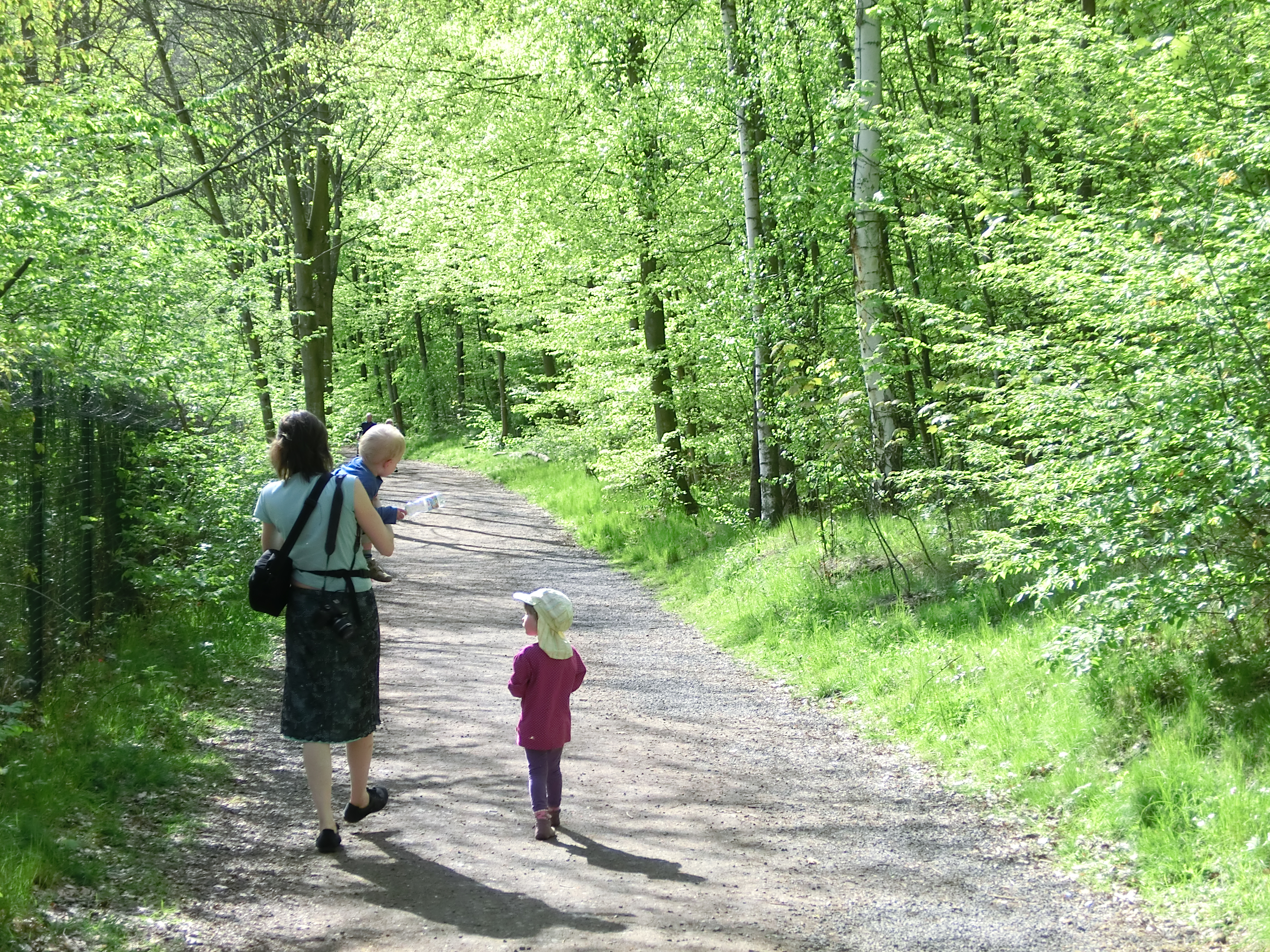
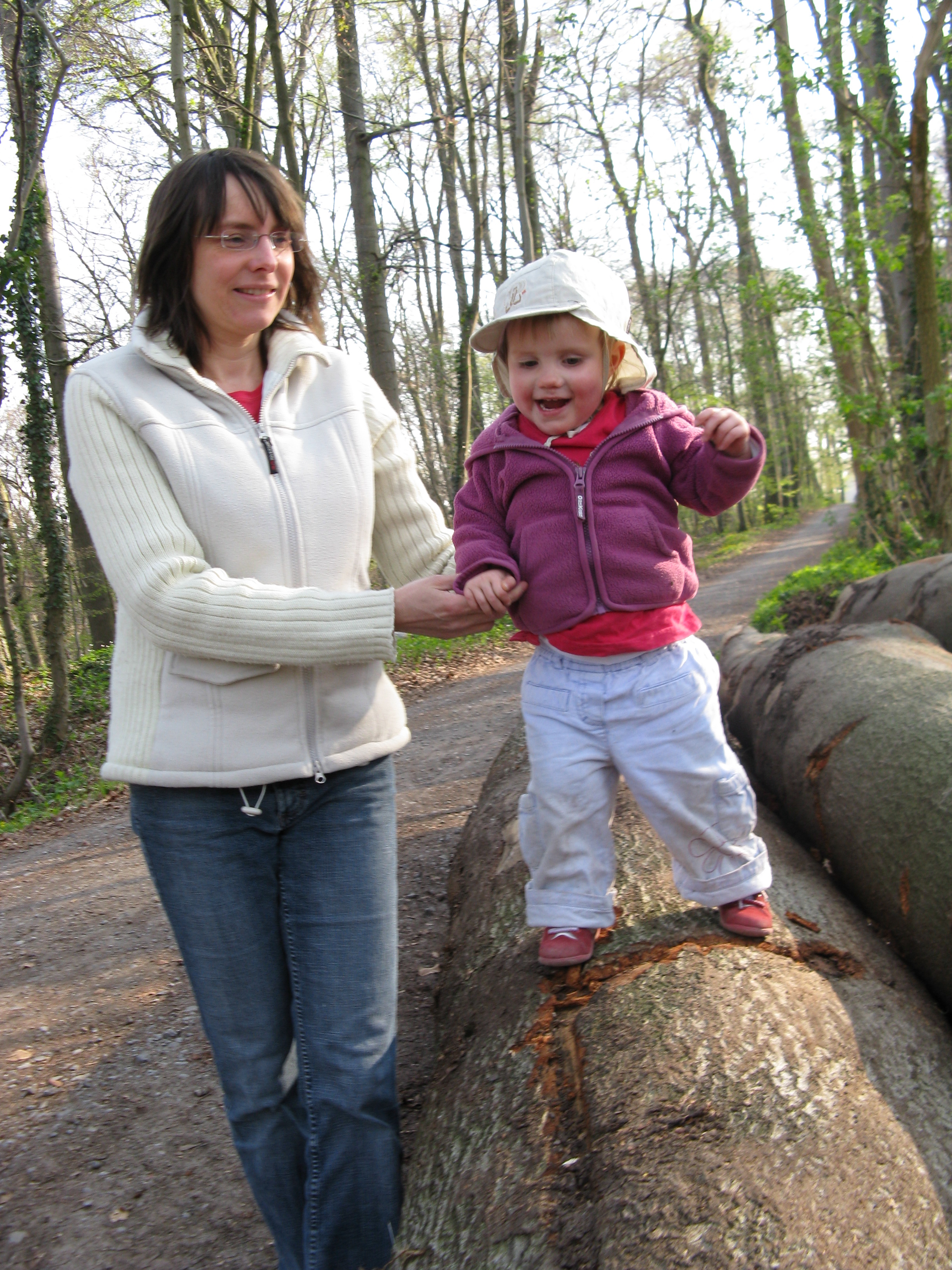
Springtime excursion in the forest; a great introduction to the outdoors

Tackling cultural differences and challenges:

Although lacking the big open spaces that I am used to in Scotland, Germany (where I live now) offers many positive opportunities close to urban areas for people to connect with nature on a daily basis. Scotland on the other hand, whilst renowned for its nature and “wild” landscapes has not always enjoyed such a good track record of providing attractive safe greenspaces for children close to where people live and work. 

Take woodlands for example; for many years I worked to improve access to green spaces and woodlands around Scottish cities including Aberdeen, Dundee and Edinburgh. In Scotland, this is still an uphill struggle and urban forests are often perceived negatively by Scottish city dwellers as being the haunt of undesirables. Perhaps this is a distant ancestral  memory of a time when wolves roamed the forests of Scotland.  However, the situation is often not helped by adverse media coverage which regularly portrays Scotland’s urban woods as threatening and sinister places. 

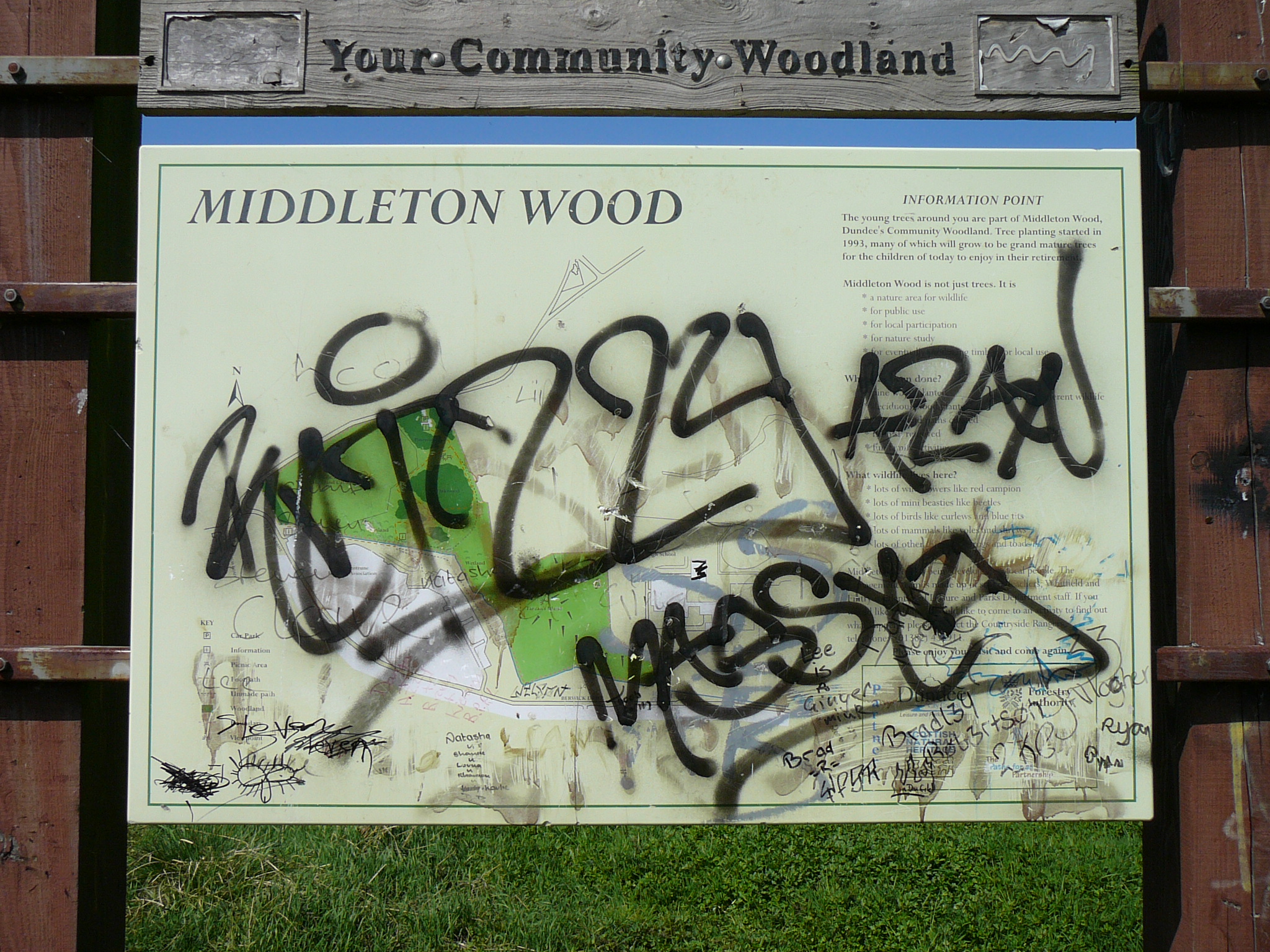
In Dundee we worked for several years to change around the reputation of the City’s urban woods. Modest success was achieved; however, this involved the woods being completely thinned out to open up visibility and the installation of offputting notices at woodland entrances warning of police surveillance. Fortunately in Scotland things are now changing due to initiatives such as Community Woodlands and the growth of the Forest Schools initiative.  Still we have a long way to go to increase public confidence in using their local forests near towns.

Scotland’s urban woods – some progress but tough challenges still ahead !

In Germany, the situation couldn’t be more different. Here woodland culture is deeply embedded into the German psyche and Germans enjoy visiting their woods with an almost religious fervor.  Most German cities boast extensive tracts of adjoining forest or “Stadtwald” which is  used by urban populations for health, recreation and wellbeing. In addition, pre-school and school children in Germany enjoy frequent “Waldtage” or forest days which allow young children to acquaint themselves with the woods from a very early age onwards.  These visits occur with a minimum of fuss or red tape which would be quite unprecedented in more health and safety obsessed Britain. 

We live close to the Aachen Stadtwald and can get there in just a few minutes walk from our house. The contrast with Scottish urban woods is striking.  On any typical evening and in the worst of weathers, you can find a plethora of (sometimes comical) lycra clad groups industriously undertaking every conceivable form of physical activity imaginable; from nordic walking, mountain biking, pony riding, roller blading, dog walking and Tai Chi through to jogging (to mention just a few). By Scottish standards the woods are quite simply buzzing !  No wonder the Germans look to me to be fitter and healthier than their Scottish urban counterparts.

Cultural issues aside, getting small kids into the great outdoors is no mean feat even at the best of times as any self-respecting parent will tell you. I was recently asked, somewhat naively perhaps, why so many children are pushed about town in buggies (or indeed carried around for that matter) when they can quite easily walk. If only the world were that simple and kids simply  followed along  in an orderly fashion without being subject to a myriad of distractions !  Fine if you have all afternoon to walk a hundred metres. However, with 2 small children thrown into the equation, the result can be akin to herding cats.

Off road buggying – first steps into the unknown: 

From an early stage on, we found buggies to be a great introduction to the joys of the outdoors.  An important discovery for us was that our small daughter would only fall asleep (in the daytime) when pushed around paths in a pram. The rhythm of the buggy gently bumping along unsurfaced paths and accompanied by relaxing natural sounds, rapidly induces a state of wellbeing and calm for the child, evidence that perhaps our ancestors were nomadic by nature. 

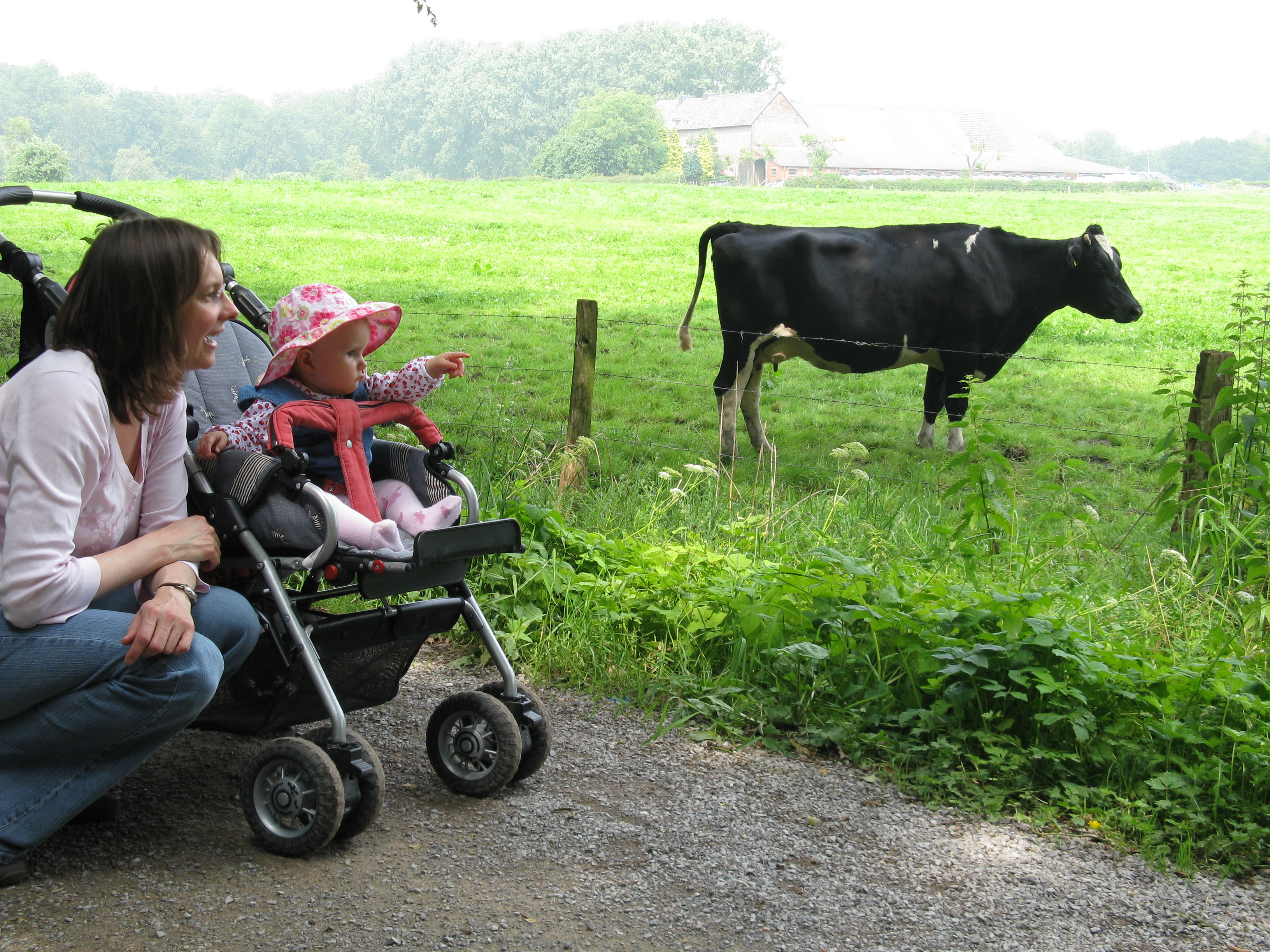
Encounters with “wild nature” on a buggy safari

During the first 2 years of my young daughter’s life, I was working in Edinburgh and was consequently only able to drop in for flying visits on an intermittent basis. During each visit, “pram walks” became an established ritual. A wooded hill in Aachen, known as the Lousberg, (a couple of hundred metres high) became my regular stomping ground. Over this period I gained an intimate knowledge of the hill, it’s wildlife, history and it’s woods. Every so often I still came across new paths and hidden corners.

Although pushing a child in a buggy up rough, steep gradients might sound somewhat of a chore, there a considerable benefits, particularly to parents. In particular there is the chance to get fresh air and much-needed exercise, two essentials when confined largely indoors with small children. The senses are also heightened when your child finally falls asleep and then you can start to tune into natural sounds such as birdsong and the rustle of small voles and mice in the undergrowth. I walked these winding paths in all seasons; through sunshine, frost, snow, gales and storms. Every time the experience was slightly different and on each occasion I  noticed something new. 

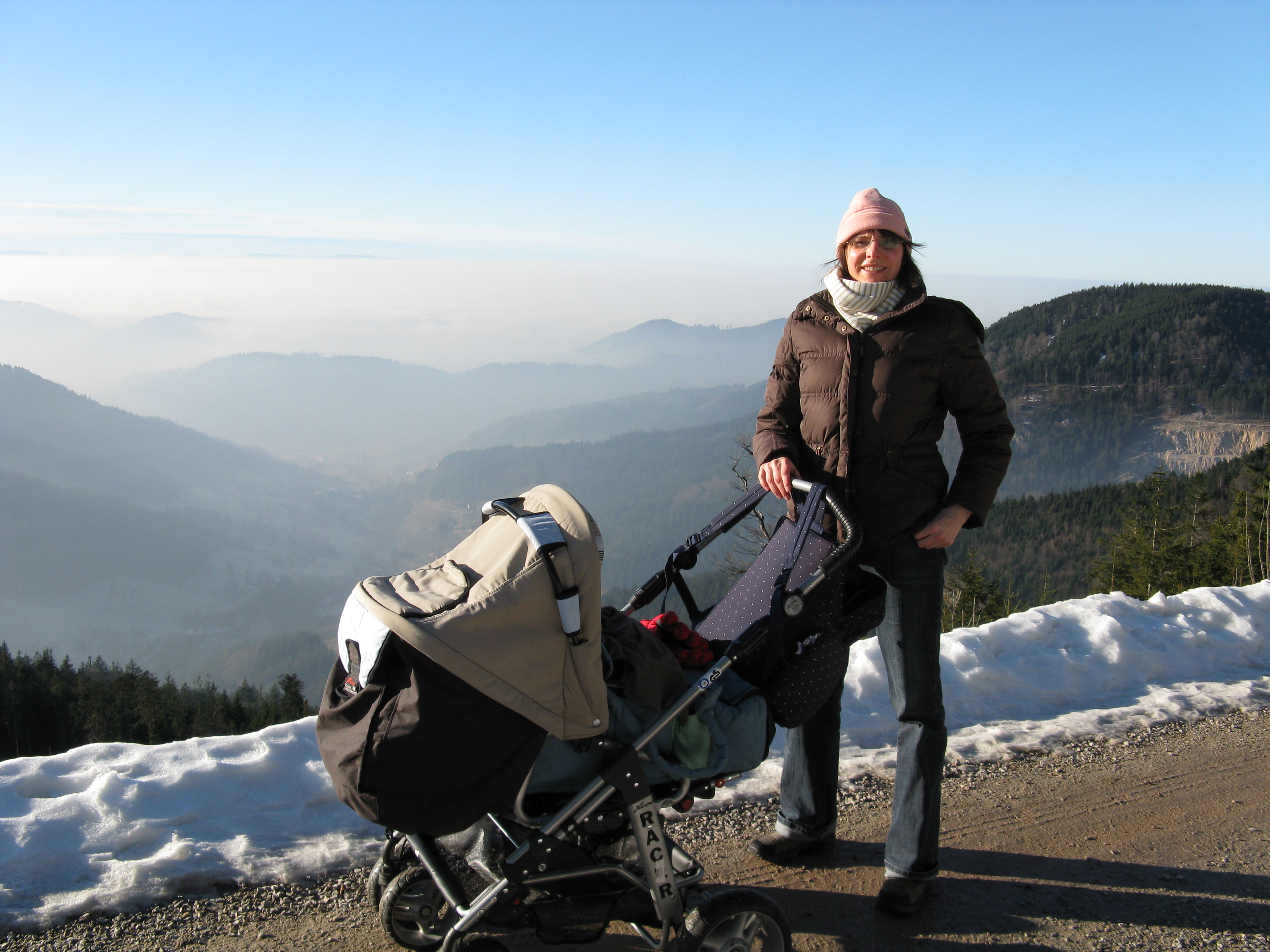
4 x 4 x Pram: winter excursion in the Black Forest

We also found that “buggy” excursions could take us further out into the countryside. This provided great opportunities for encounters with “wild nature”. For young minds anything on legs is exciting. A trip along a farm track featuring encounters with cows, ponies or sheep proved to be the kids equivalent of a visit to the Serengeti for adults. This was a great source of motivation in terms of getting kids out the house. There are even several small urban fields in our locality where cows are kept within the town. “Going to see the cows” has been a great motivational factor for us to get the children outside in the fresh air.

Play areas –  an apprenticeship for greater things ahead: 

Another great resource for familiarizing our children with the outdoors have been play areas. I had always perceived these somewhat negatively as being the lowest common denominator in terms of outdoor play provision; dull, artificial environments with engineered attractions. In Britain play areas are often run down, windswept and unattractive places plagued by poorly maintained infrastructure, litter and vandalism (admittedly this is starting to change thanks to the good work of organisations like Greenspace Scotland). In Germany we have found play areas to be generally more imaginative in their design and providing greater opportunities for kindling small children’s interest in their surroundings.

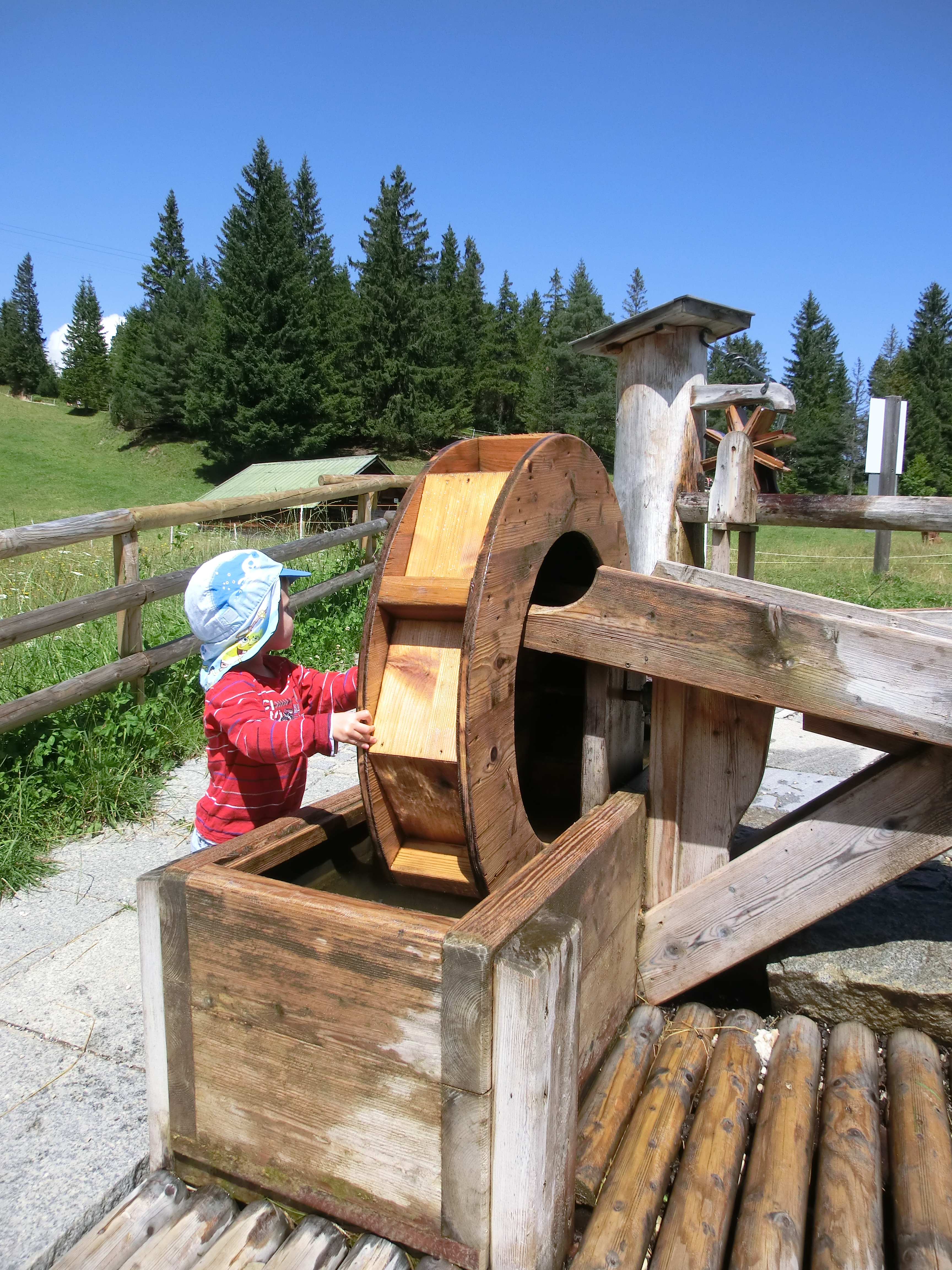
Imaginative play area in Bavaria; water and sand are key features

The three elements which my children have found to be most of interest are water, sand and climbing potential. Play areas in Germany usually excel in providing each of these three elements in abundance. Sandpits are a feature found in just about every playground and these are often accompanied by a water pump which allows kids to get both dirty and wet. What could be better !

There are also plenty of climbing opportunities, usually pitched at a level that will challenge the different age groups. Sometimes these take the form of strategically felled trees which are left to provide a natural climbing facility on the edge of a more formally managed play park. Sometimes it’s not even clear if these are there by accident or by design which perhaps increases their appeal.

Scared wells and healing waters:

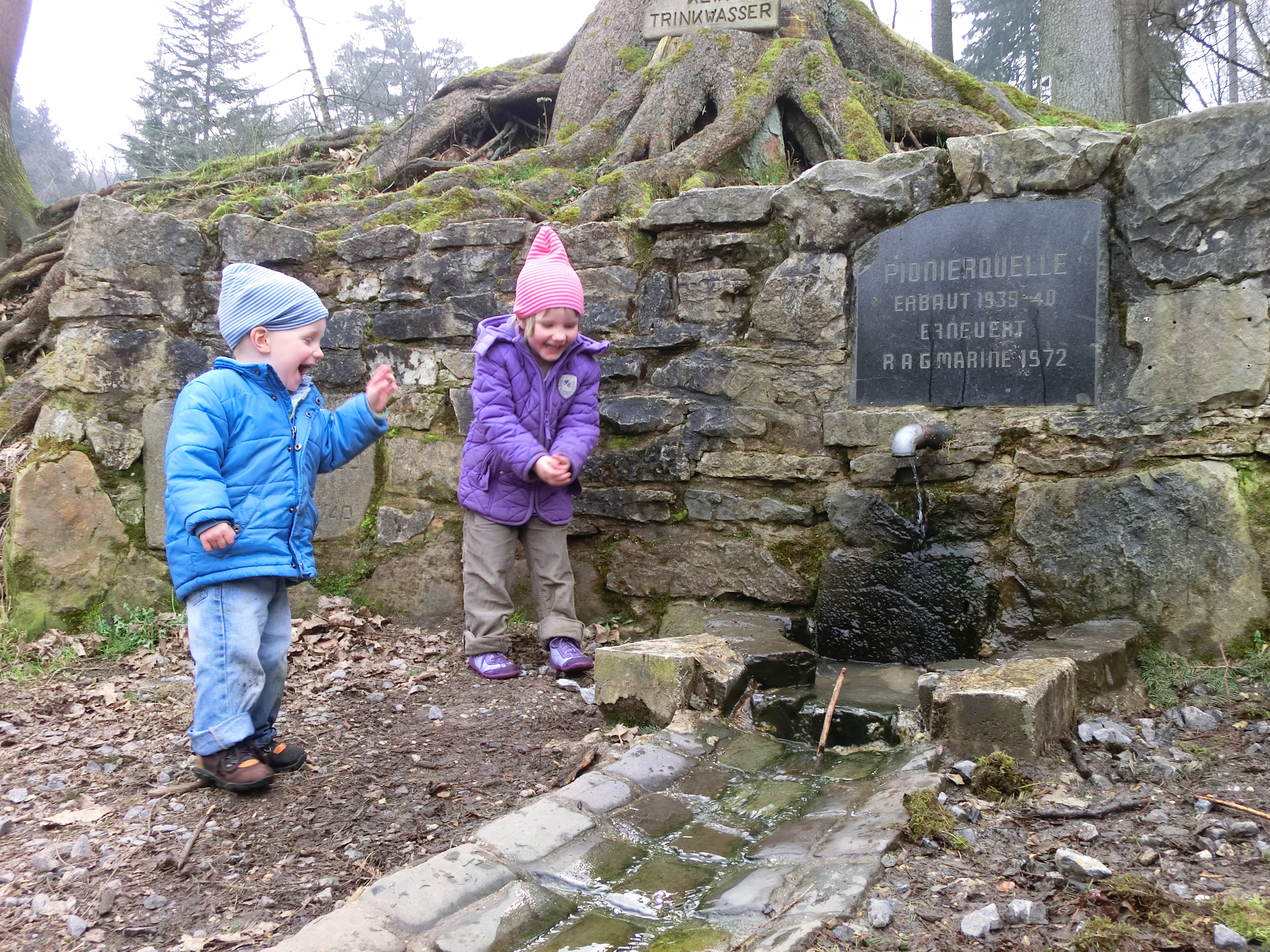
My kids are completely hypnotised by running water and rapidly become absorbed by any fountain, well or small stream. We quickly moved away from more formal urban playparks in favour of locations in the forest where we have found a couple of “adventure” style facilities. One of these boasts a well with a cleverly designed scoop which picks up water and lifts it uphill onto a trough. The children simply love this and could quite easily spend all day playing there. The contrast with the barrage of moaning and complaining that we are subject to when the children are stuck  indoors could not be greater.

Woodland pixies playing by a secret well

This is something that I particularly noticed with my young son. Before he was too small to go to nursery, I was charged with looking after him during the day for a period of six months. When we were stuck indoors his behaviour was quite simply impossible and  he would rapidly become bored and disruptive, despite my best attempts to interest him in toys, books and games.

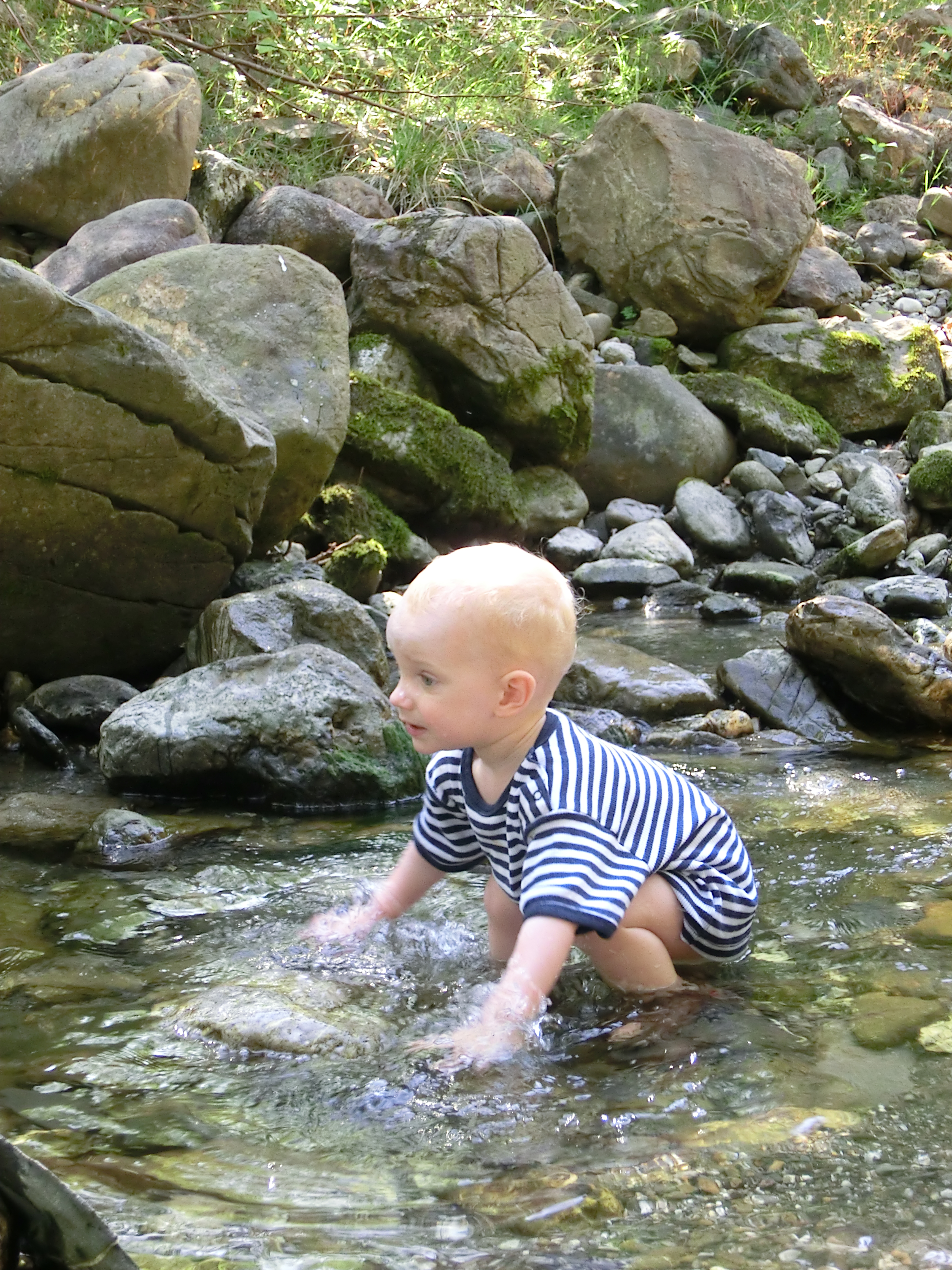
Consequently, I opted for a more radical approach and decided that the only way forward was to get him outdoors and into nature. We would often take excursions deep into the woods where we would find a quiet spot where he could play undistracted by a small stream. 

The resulting change in behaviour was dramatic. After some initial protests he would quickly settle down and soon be completely absorbed in his surroundings, enchanted by small leaf boats floating down the stream or by the splosh of pebbles landing in water. It was clear to me that kids really do need to have the opportunity to play outside and that “Nature Deficit Syndrome” is not something merely dreamt up by a few scaremongers.

Kai; always happy where there is water

Freedom or beast of burden ?

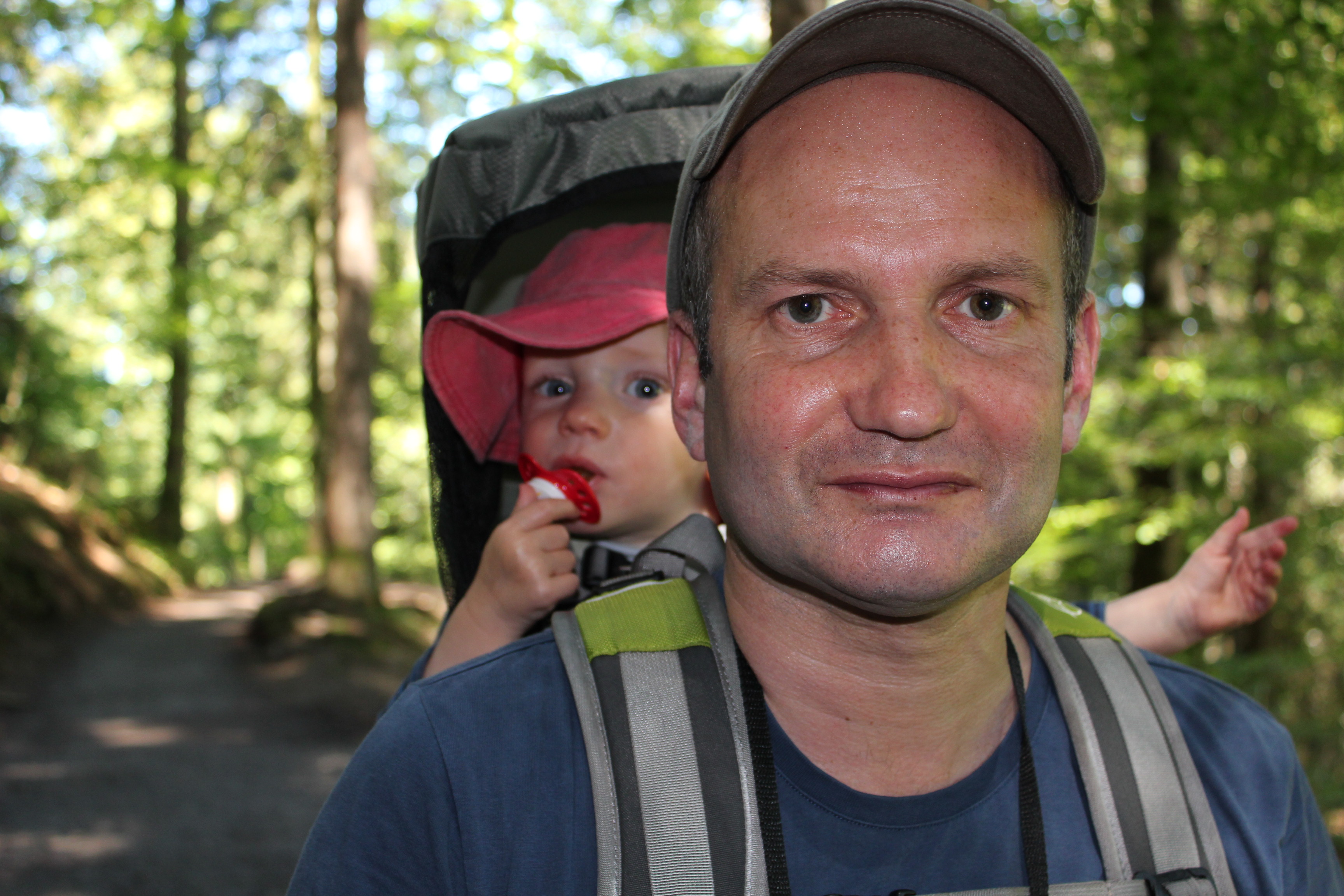
An other useful accessory that has helped up to survive the first few life-changing years with children has been a child backpack. I bought one of these which was rather optimistically called “Freedom”.  As anyone with children will testify, carrying around 10kg of moaning child on your back (and up steep slopes) is far from any normal perceived notion of freedom. However the backpack did open up many new horizons for us as it allowed us to make excursions into the mountains away from tarmac and urban infrastructure.

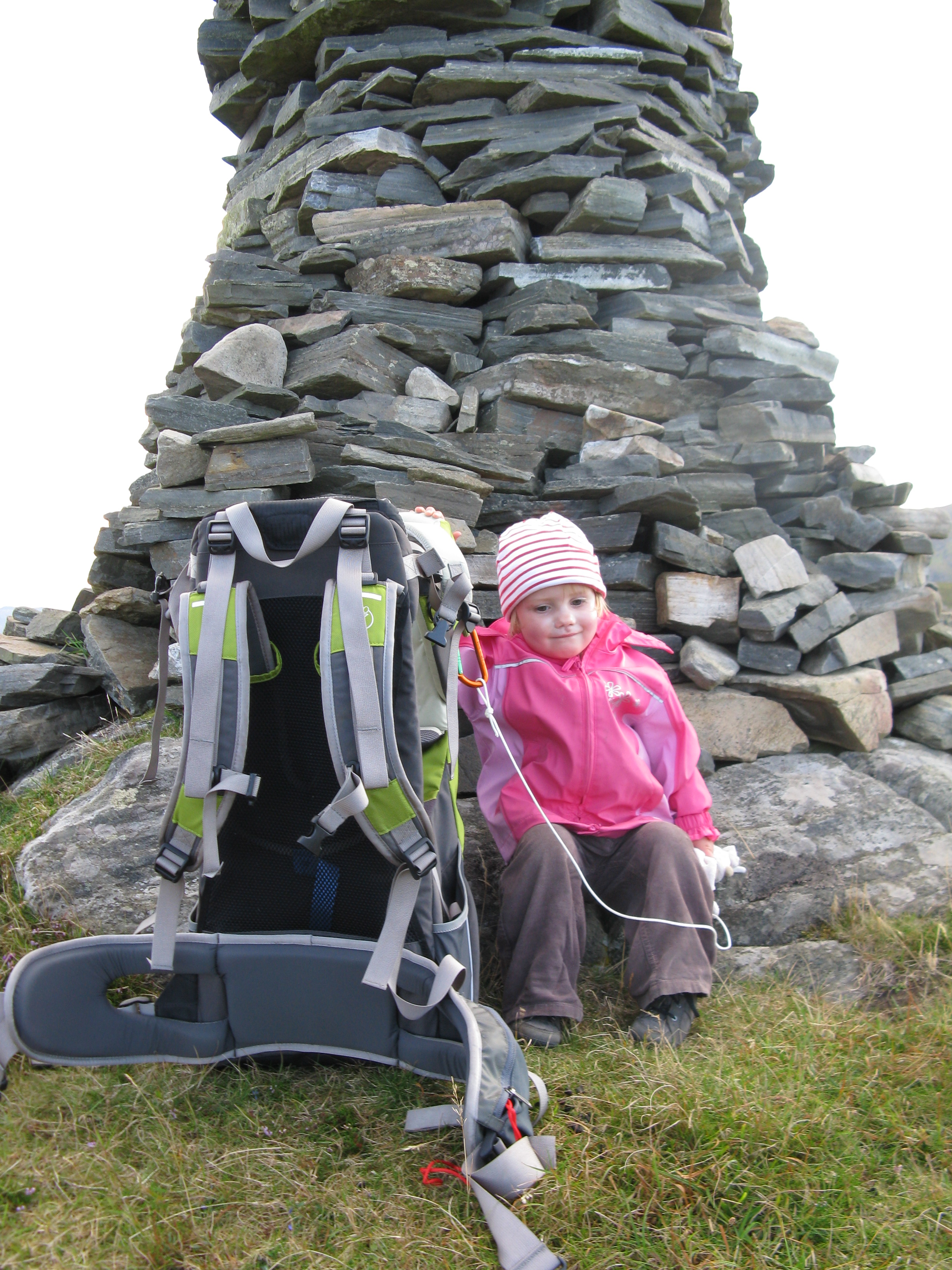
OK, it was hard work though ! My daughter achieved her first “backpack peak” when she was 2; a modest, windswept and heatherclad hilltop on the West Coast of Scotland with a view looking out across the islands of Skye, Rhum and Eigg. Although she had literally been carried all the way up and down the hill by my good self she was, nevertheless, very proud that she had reached the top of a Scottish “peak”.

At the bottom of the hill we spent time playing on the beach and investigated marine life in the rock pools. We have found that it is important that children are “unpacked” at regular intervals during a trip to allow then to play and explore their environment at close quarters. This allows them to make their own small discoveries as well as getting some exercise.

“Bagged Peak” – Zoe’s first small summit by backpack, by Arisaig, West Highlands of Scotland

“Childpacking” Alpine style:

On later journeys in the Alps, in Switzerland and Bavaria, we found the backpack was again an indispensable tool for getting kids (and ourselves) out into the mountains. Our ultimate goal was not peak bagging but was merely to get the family out and enjoying the alpine environment. Often we would make use of gondolas and cable cars to get the tricky, steep bit out the way. My young son, Kai, could not get enough of gondolas and cried without fail at the end of each trip. There is a kind of magic of gliding effortlessly over woods and alpine meadows which particularly appeals to kids.

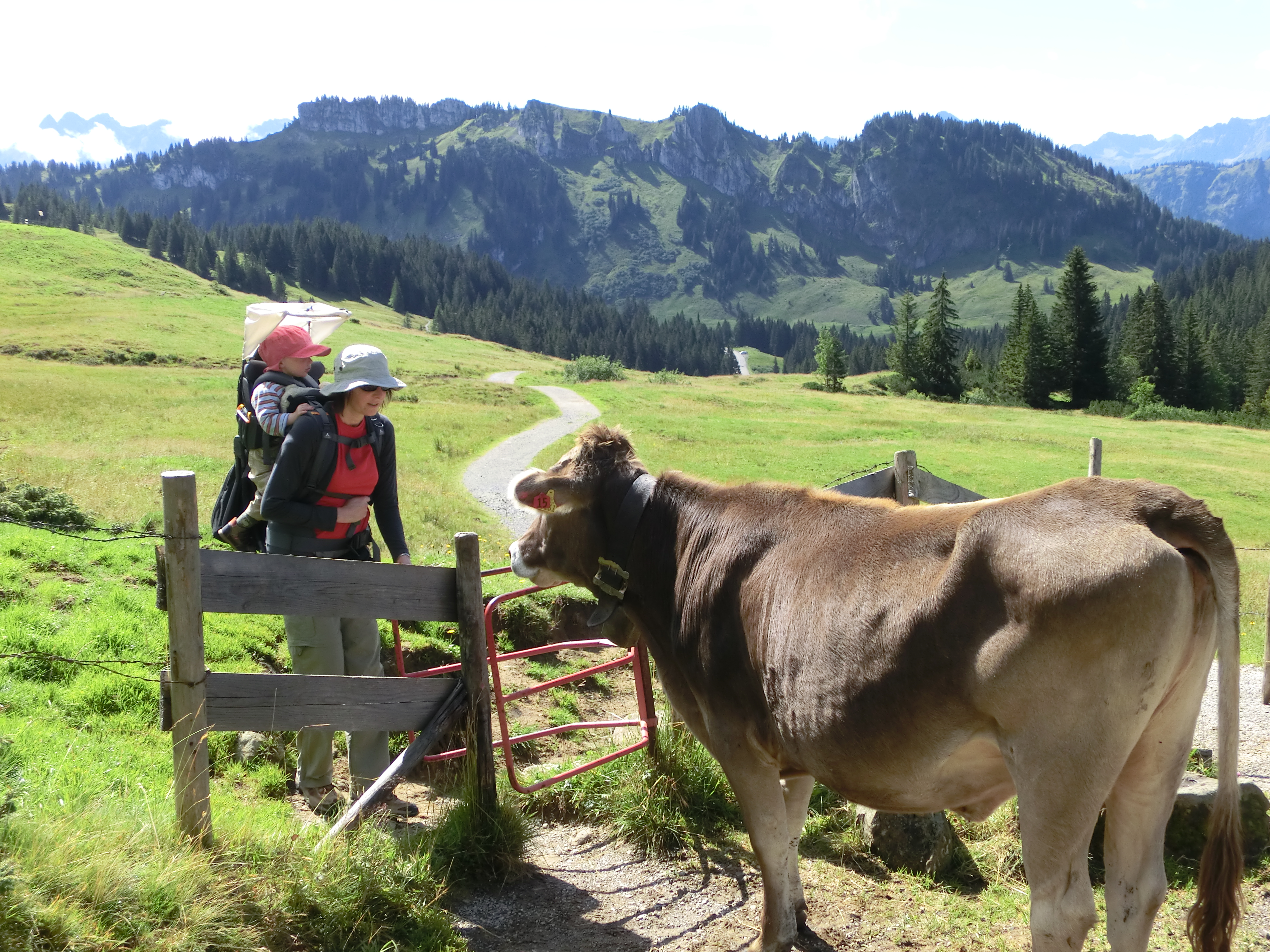
Getting acquainted with the locals in the Alps

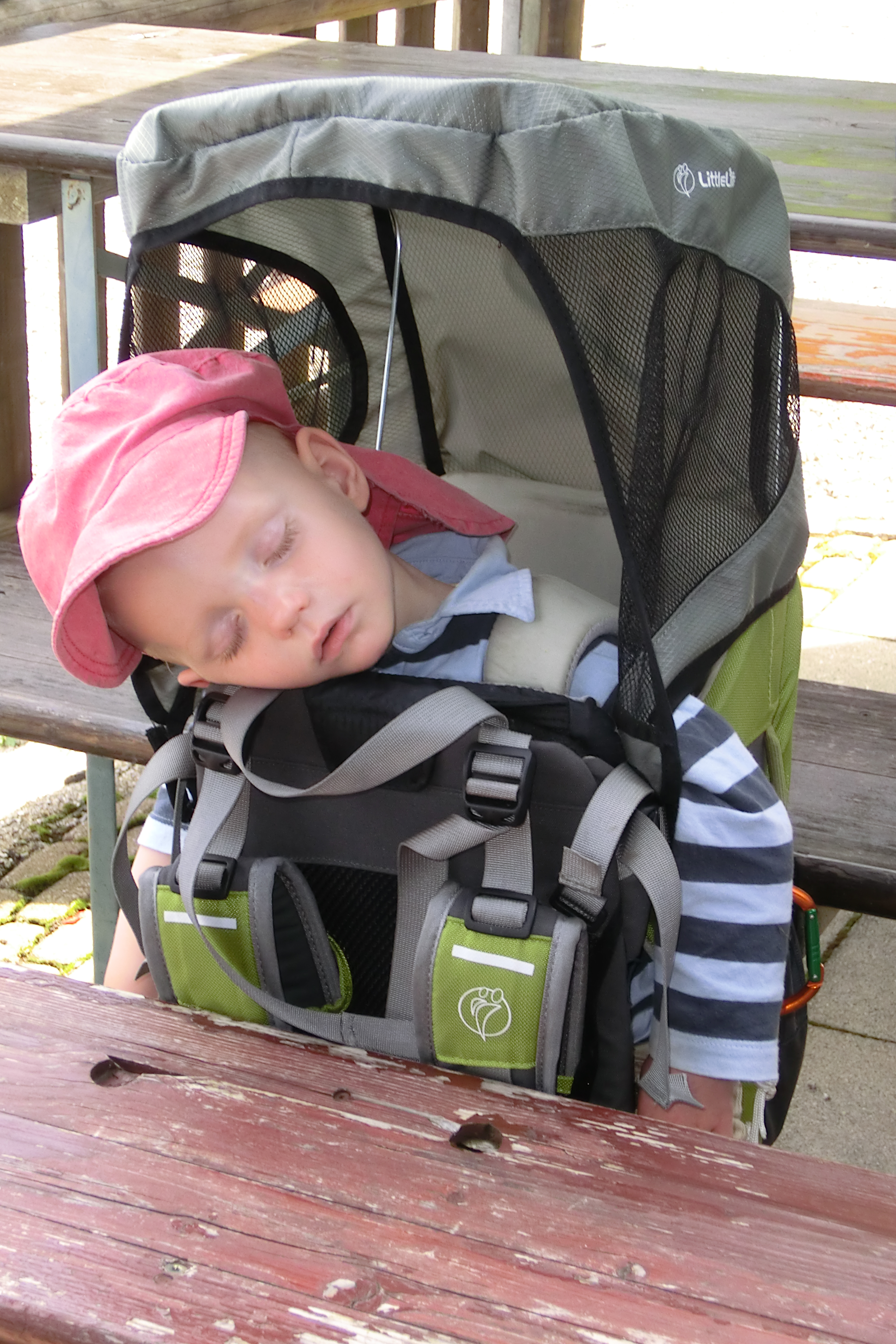
From the top gondola station, we would walk  as far as seemed comfortable before siting down to enjoy a picnic amongst alpine meadows.  This would allow the children (and ourselves) to appreciate being out in the mountains without placing over ambitious goals upon everyone. We could then take it in turns to go off and bag a small summit while the children played and explored their immediate surroundings. We even found that sometimes my son would go to sleep in the backpack as we walked along. With a bit of care the backpack could then be removed with the unsuspecting Kai still asleep inside. Ideally this would coincide with a stop at a mountain cafe and the  pack could be propped up against a table while we enjoyed a Bavarian “pint” free from restrictions.

Backpack sleep break; well timed for the beer garden

Trips in the alps have also been enlivened by chances to visit small mountain Almhuts (meadows) serving local produce.  This is one novelty of being in the Alps which never ceases to amaze me and one which contrasts strongly with our spartan Scottish hills where it’s strictly a case of bringing along your own “piece” for lunch.  Enjoying a relaxing lunch or a beer in an Alm Hut is a very civilised experience indeed. The children love to encounter cows grazing on the meadows and are thrilled to bits by the happy lilt of cowbells drifting across the meadows, an image surely straight out of the sound of music.

Dad takes the strain

Putting food into the equation is rule no. one  for getting children out-of-doors. Food needs to be there, tasty and reasonably abundant enough to provide sufficient incentive for expeditions to take place. We always take a back pack with a range of small treats and goodies which can be dished out periodically along the way. This not only provides encouragement but also a much-needed energy boost. However, when  food becomes the dominant purpose of the day, care needs to be taken to avoid constant “grazing” with its accompanied gripes and complaints of “Mummy, I want this.., Daddy I want that…”.

Usually we find it’s better to aim for one or two more structured food breaks; that way the kids concentrate on other things they encounter along the way rather than pestering parents to distraction with unsatisfied demands.

Outdoor novelties :

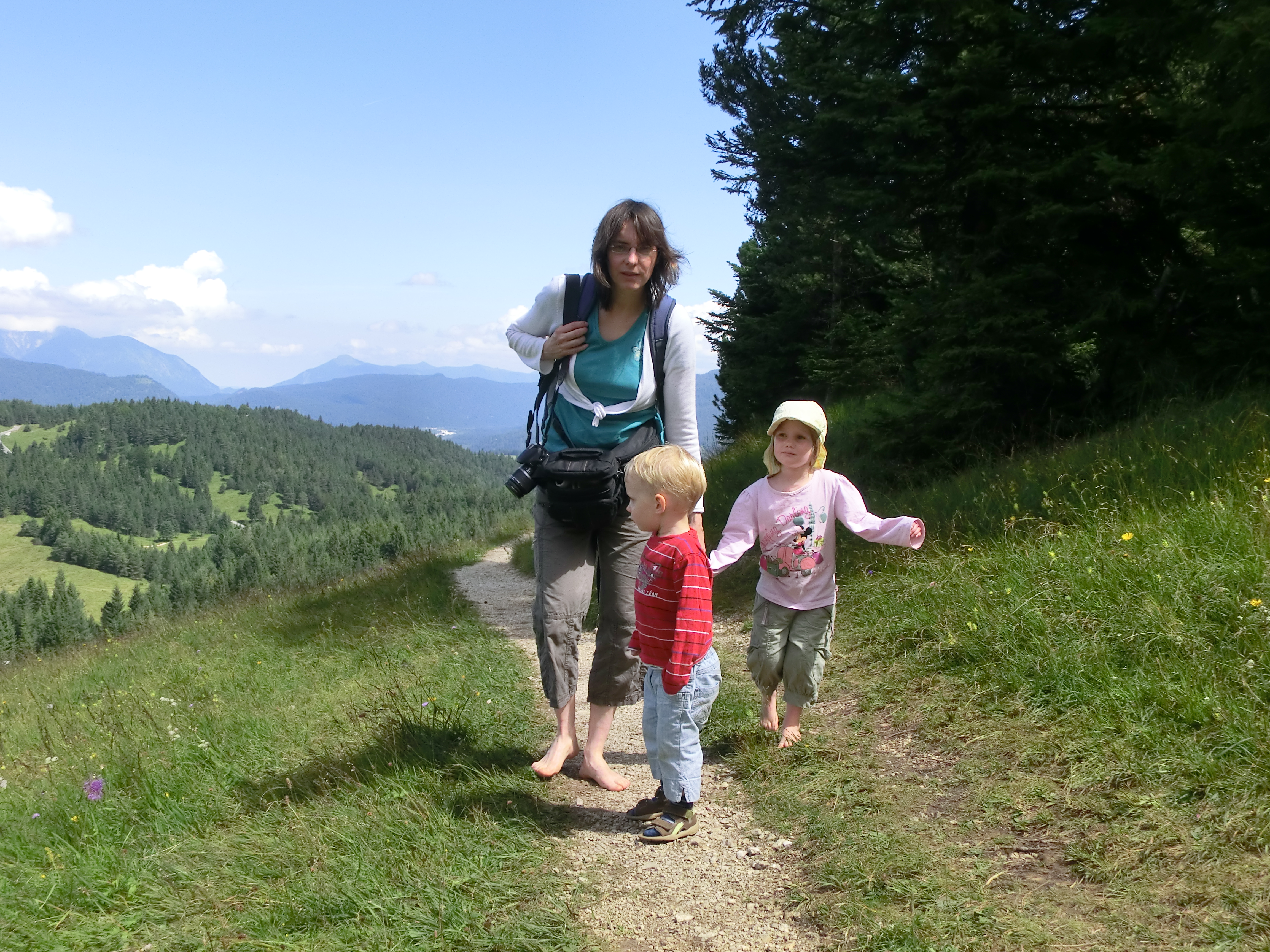
Where possible it’s also interesting to find new and unique outdoor experiences for kids. Near Mittenwald in the Karwendal Alps we came across a “Barefoot Trail” which circumnavigates a mountainside covering a variety of terrain and surfaces, ranging from squelchy bogs through to gravel chips and upturned logs.  The Barefoot Trail is accessible by an old-fashioned chairlift which makes a wonderful introduction to the day as you glide effortlessly along level with the tree tops. The whole experience is a deeply sensory one which enables children to learn about the natural world literally through getting their feet muddy .

And now for something completely different; barefoot walking in Bavaria

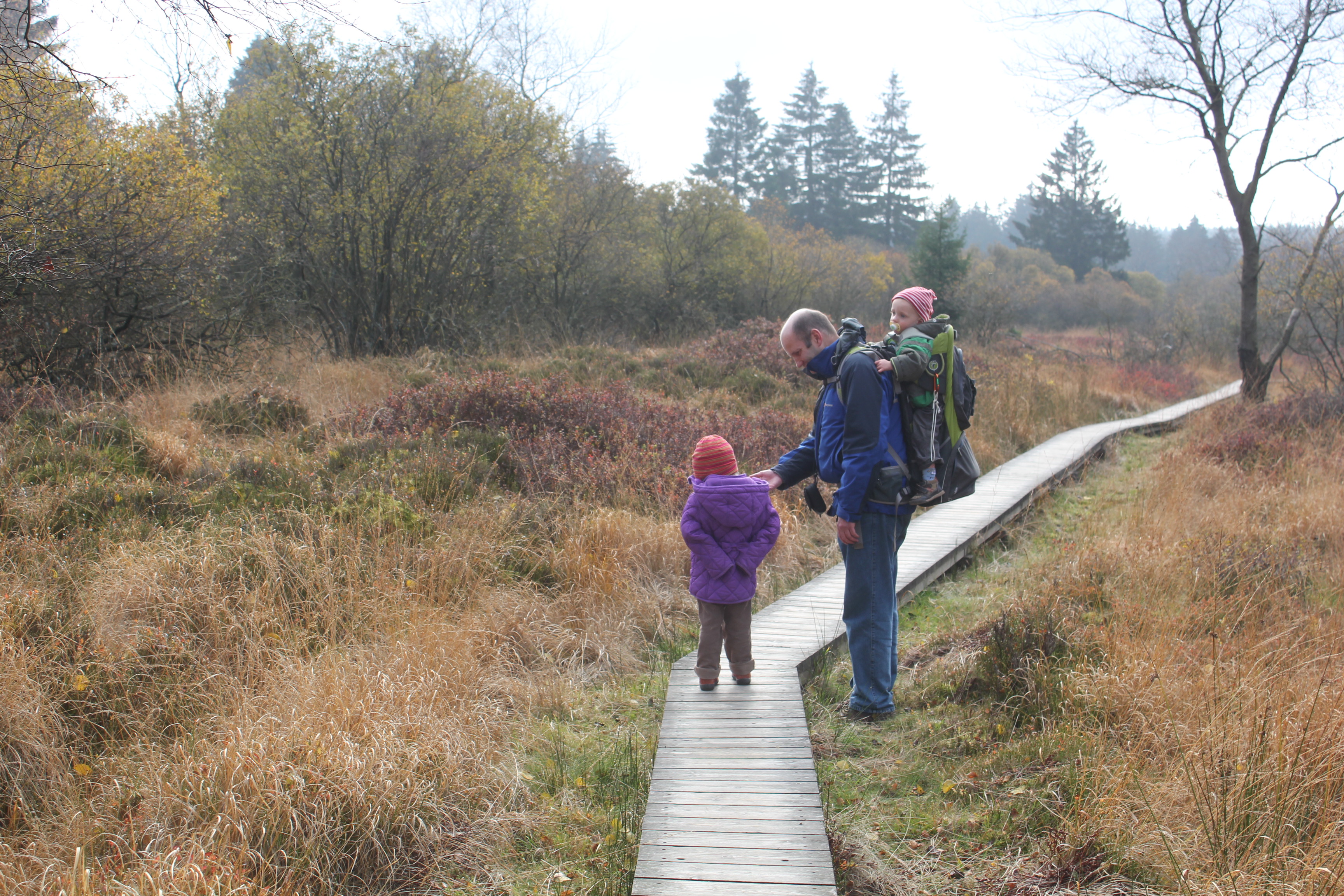
Novel experiences like this tend to go down well with the kids and help to liven up what could otherwise be a  fairly run of the mill walk.  Wooden board walks are also a source of great interest and curiosity and demand to be explored further by curious kids. Young explorers can run along the boardwalks and pretend that they are on rail tracks (or “toot-toot” as my son calls it).

Boardwalks; an exciting new experience for the kids

Climbing, collecting and creepy crawlies:

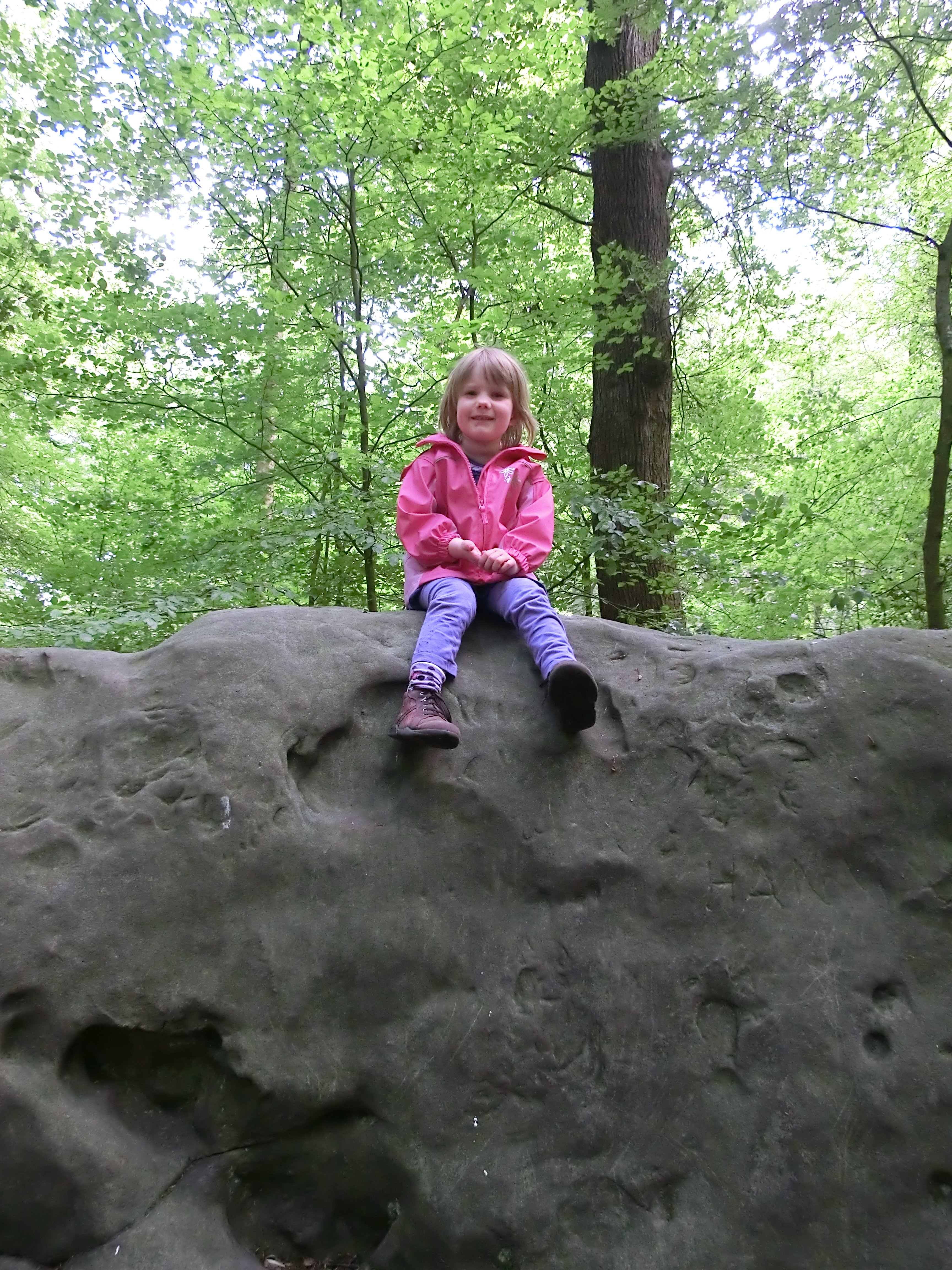
Anything  involving climbing is also highly sought after by kids and can provide important opportunities for physical development as well as increasing confidence and risk awareness. My kids started climbing  mostly in play areas where some excellent facilities provide a good introductory training ground. They soon progressed and are now keen to tackle any suitable object which is fit-for-purpose.  Current climbing challenges include boulders and trees and stumps.

Just up the road from our children’s nursery is a small and long-suffering hazel tree. Each day, after being retrieved from the nursery, Zoe and Kai make a beeline for this and (often to our annoyance) commence climbing activities. Other kids also converge on the poor hazel tree and swarm over it like locusts to see who can get the highest. At this point somebody usually tries to be too ambitious and needs to be rescued amidst a flood of tears; however usually it’s all great fun in the end and nobody gets hurt. We also found a fascinating place in the Aachener forest where kids can practice “bouldering” skills on some large and unusual stones.

Bouldering in the Aacher Wald

From our experience, anything that involves collecting, exploring or discovering in nature also tends to go down well.  Last week, on the way home, I decided to make an unscheduled stop-off at a woodland car park . I was foolish enough to suggest to the children that we go for a walk. Obviously this went down like a lead balloon and I was immediately met with protests and voices of dissent.

The mood changed immediately however when I explained that, instead of going for a walk, we were going on a “collecting and foraging adventure”. Plastic bags were pulled out of the car and I suggested that we filled these with any interesting detritus that we might find. With this change of emphasis, the kids were off like a shot and soon our supermarket carrier bags were brimming over  with a cross-section of  nature’s treasures including bark, stones, twigs, autumn leaves, cones and pine needles.

Back at the ranch we sort out and identify all these collectables. Autumn leaves are great in terms of their potential for producing artworks and colourful posters. Last year we pinned all the most interesting specimens up on the wall and then took them down again in the spring when the new leaves appeared on the trees.

Conkers are also of considerable interest to kids. At this very moment we have several heaps in our living room ready to be made into something unusual and arty. We have also tried collecting and growing tree seeds. Last year we started with acorns, however these became saturated in the spring rains and did not grow. We need to repeat the experiment this year and hopefully get it right next time.

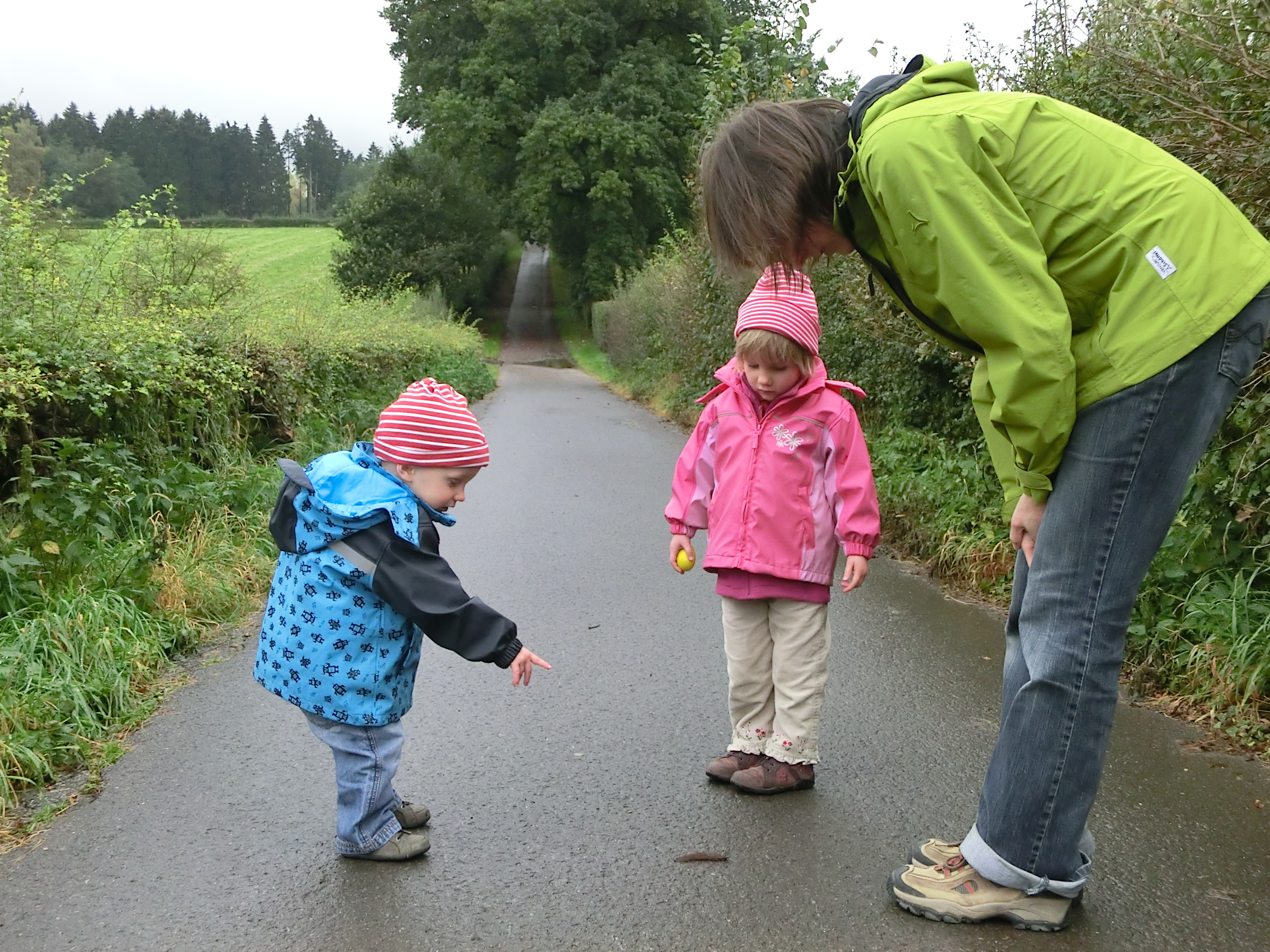
Slug spotting !

Creepy crawlies, including beetles, snails, slugs, worms, spiders and bees hold a particular fascination for my young son Kai. He is never happier than when he is watching bees busily collecting pollen from flowers or when slimy slugs make their way across the path in front of him. Dung beetles are very much the love of his life at the moment and he gets most upset if he finds one that has been inadvertently squashed on a path. The sight of pony “poo poo” being excavated and lifted by a dung beetle is a cause of ecstasy for Kai. Wood ants and their nests have a similar effect and are observed intently.

Birds and mammals are of interest to kids particularly when they’re close up; recently we (most surprisingly) came across a family of Siberian chipmunks in the Achener Wald. These were a source of great amusement and were foraging in amongst Himalayan Balsam (yet another alien introduced species). Whether or not species are biodiversity friendly or not is relatively unimportant for kids; some of my own best wildlife moments as a child were spent watching grey squirrels (a species now much maligned for its impact on native red squirrel populations) in Edinburgh’s Princes Street Gardens.


Elves, witches, music and magic:

It’s really important never to forget the magic of the outdoors. Woods for children can trigger and stimulate  so much within the imagination. We go hunting for gruffalos and  look for woodland fairies, giants and witches. We build houses of sticks and make offerings and magic potions to give to the woodland elves. It’s all great fun really and gets the kids to participate and scamper about enthusiastically with the latest project. 

To make things work often requires adults to let their own hair down a little and to get into a bit of role play; the rest will follow on naturally. There is no end to the range of potential themes which can be undertaken. possibilities include woodland puppet shows, story telling, music, drumming, theatre and dance.

Despite urban lifestyles, I think the human psyche is still deeply rooted in nature and the changing of the seasons. So many of our fairy stories and traditions, from “Little Red Riding Hood” through to “the Hobbit” feature woods, wild places and fantasy creatures.  We find our kids also tend to move a little faster when the witches and giants are pursuing them down the path; conveniently the witches (good and bad) tend to appear just as its getting dark and we need to get home quickly.

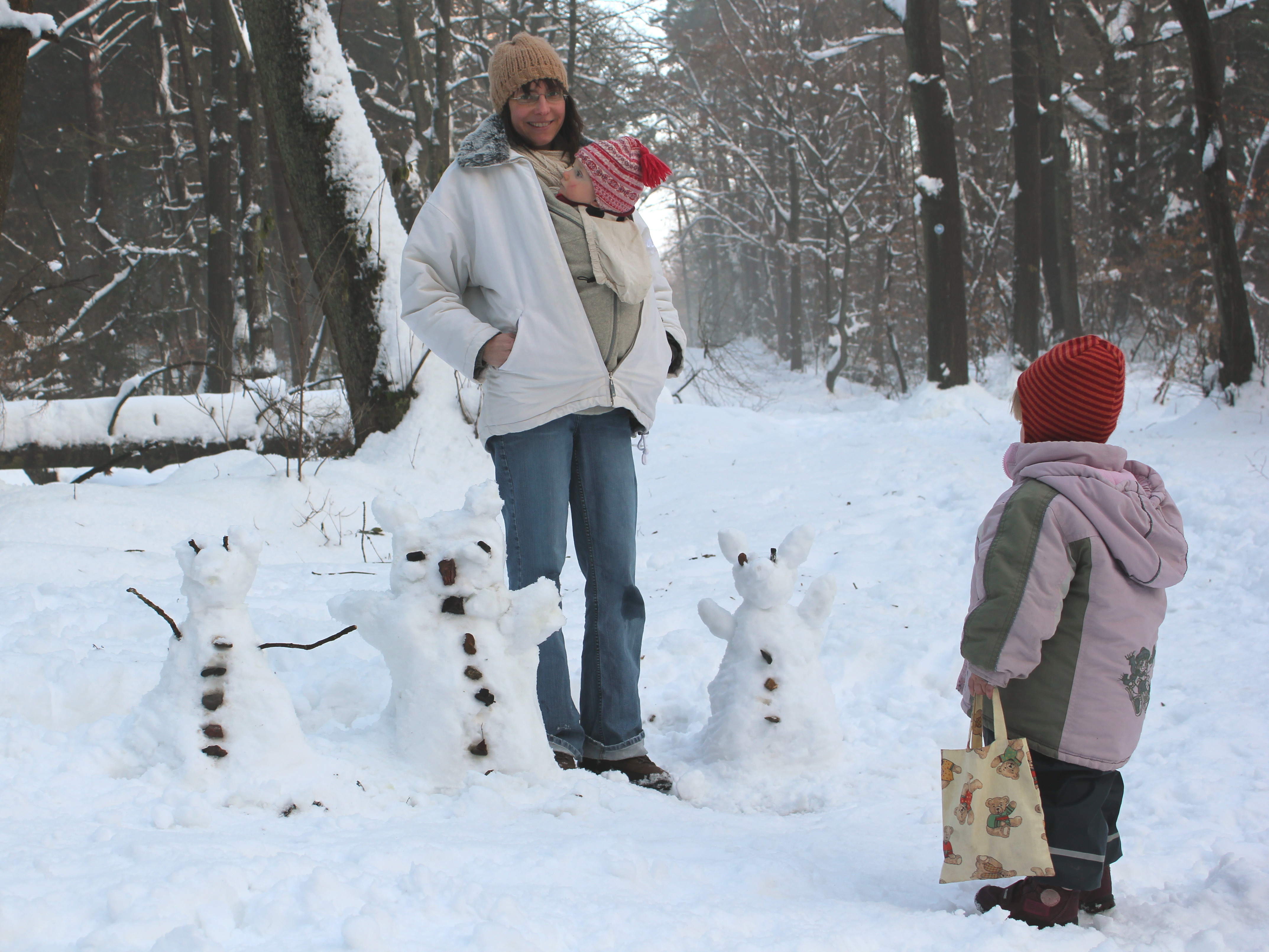
Getting creative; building woodland creatures out of snow in the Aachener Wald

And so we did it !

And so I’ve hoped to show here some simple ways of getting kids out of the house and back into nature where they (and we) ultimately all belong. This shouldn’t be a struggle; it shouldn’t be about forced marches plagued by voices of dissent (although this may often be the case). It’s simply a case of slowly moving the goal posts further afield through time and inviting your child to participate at the next level of challenge when they are ready and able to do so.  The role of the parent is to support and guide the process and to make the outdoor experiences as positive and entertaining as possible. The main thing is to have fun and to use your imagination. That way, being outside will never be a bore for either adults or children.

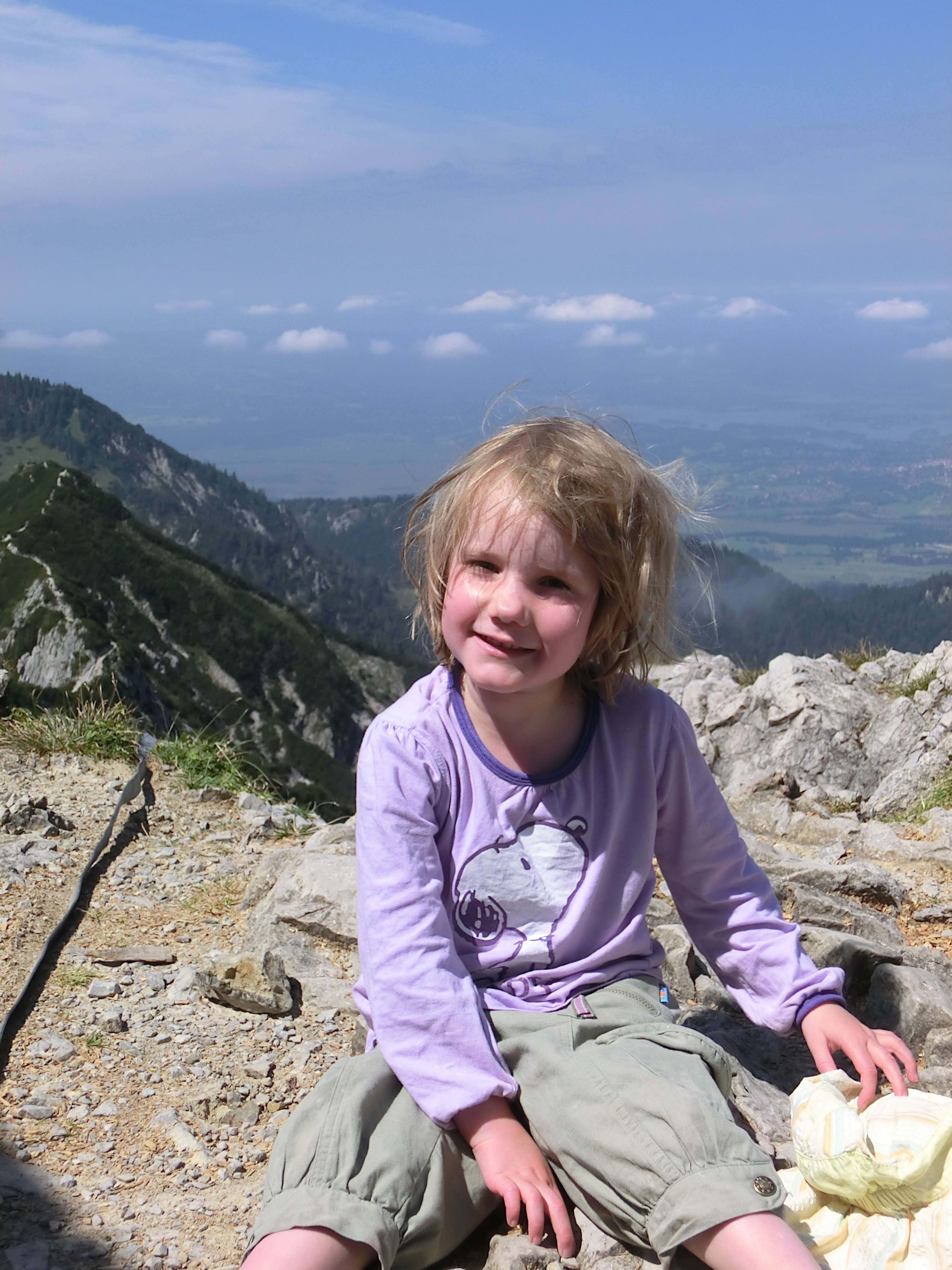
And so back to where we started. Zoe and me did reach the top of the Hezogstand on a still August afternoon last summer. After zigzagging  slowly up the path for an an hour or so we stood on the summit gazing out at the sublime mountain panorama stretching off in all directions and across the plains towards Munich and the North. On the way up Zoe told me, “Daddy I don’t like climbing up hills but I don’t complain or moan about it at all”.  A positive message of endorsement if ever there could be one !

“No complaints”: Zoe proudly sits on the summit of Herzogstand

Posted in Aachen & Euregio, Family, In Europe, In Scotland, Mountain Treks, Trees & Greenspaces, Wild Places | Tagged , , , , , , , , | Leave a comment

A Wrong Turning in the Bavarian Alps

It was one of these all too rare occurences these days; a child-free day alone to explore the dramatic Bavarian Alps in solitude and tranquility. Martina, my partner, had offered to look after our 2 young children and I was allowed out; unleashed to rediscover the once all too familiar world of mountains, lakes and valleys.

Like a captive bird, unexpectedly released from its cage, I dawdled somewhat hesitantly in my newfound freedom. I pulled on my walking boots and pontificated over what provisions to take before heading out the door, slowly at first, but then with a growing sense of purpose as I realised that the Bavarian Alps were mine, all mine, for the day.

The course was set. From the picturesque mountain resort of Krün, under the flanks of the spectacular Karwendal Alps, I headed up through a scented forest of spruce and pine towards my objective; the crystal clear Soiern Seen lakes nestling (at 1616m) below a dramatic circle of mountain summits.

Morning mist over the River Isar in Karwendal Alps

The Soiern Seen were once a haunt of King Ludwig II, the legendary Bavarian monarch famed for his eccentric building projects which, most famously, included the remarkable fairytale castle of Neuschwanstein. Ludwig’s Soiernhaus was a much more modest affair in comparison, a simple hunting lodge where royal guests were entertained. Whilst Ludwig had no personal interest in hunting, he made pilgrimages to surrounding mountain summits such as the Schöttelkarspitze (2050m) where he even had a pavilion constructed to enjoy mountain panoramas in blissful contemplation.

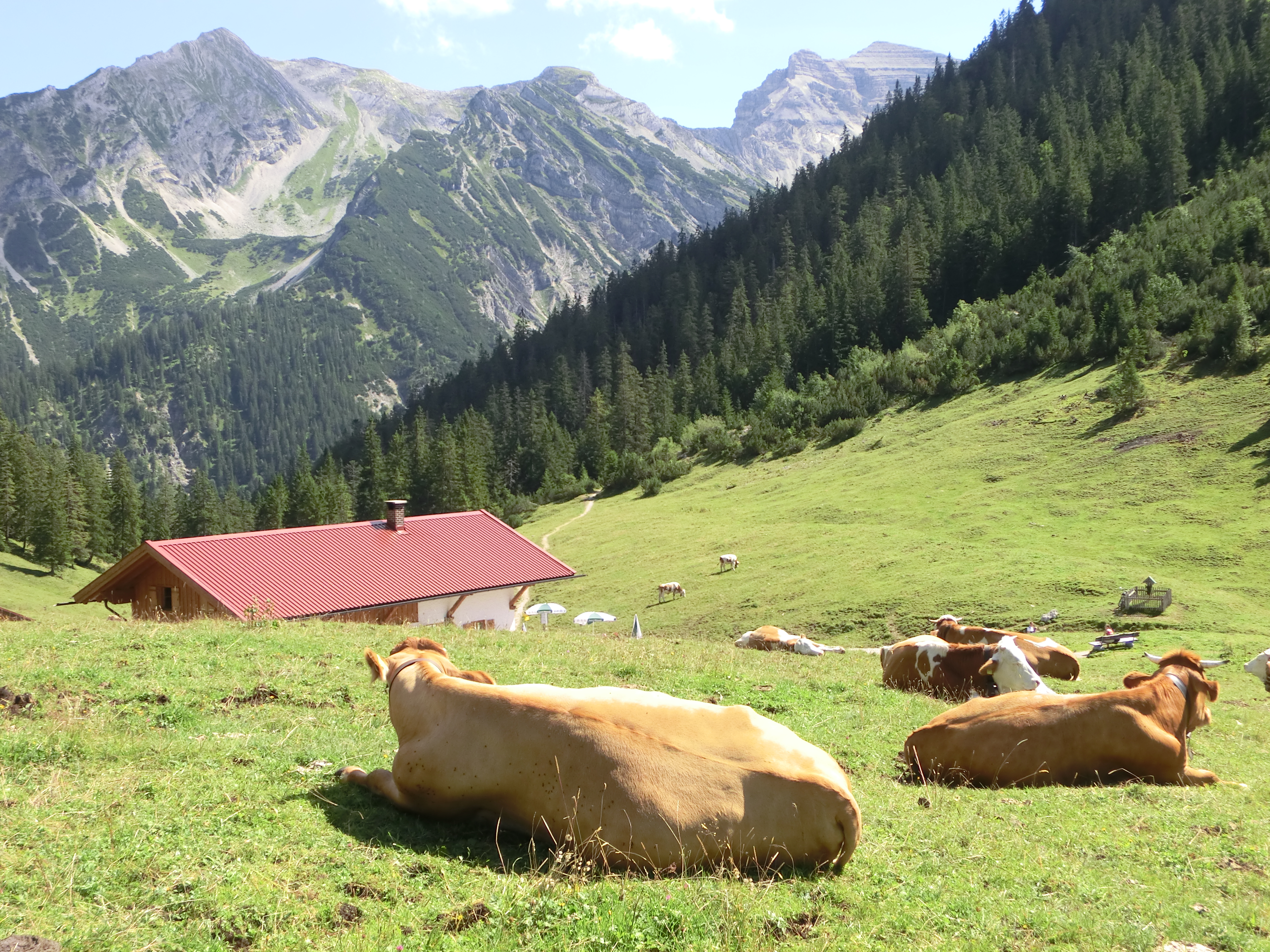
Following Ludwig’s footsteps and now gaining momentum, I pushed ahead up the steep path through the forest, the villages of Krün and Wallgau receding into the distance below and fresh mountain vistas opening up all around.  I soon reached the first objective of Fischbachalm at 1400m. Here the forest opened out and cows grazed placidly in a sunny alpine meadow. 

Pastoral scene at the Fischbachalm

Against a cheerful chorus of cowbells I sat down at a small Alm hut serving Bavarian specialities (including dumplings, cheeses and goulash soup) and enjoyed a well-earned break. A portly Bavarian lady brought me a much appreciated “Apfelschöle” to quench my thirst.

Refreshed and ready to go I set off on my way again, somewhat casually selecting the seemingly more direct route to the Soierenhaus in contrast to the longer “Tourist Path”. The direct route appeared to contour around the valley slopes in preference to the main path which followed the valley bottom before zigzagging steeply up to the lakes. 

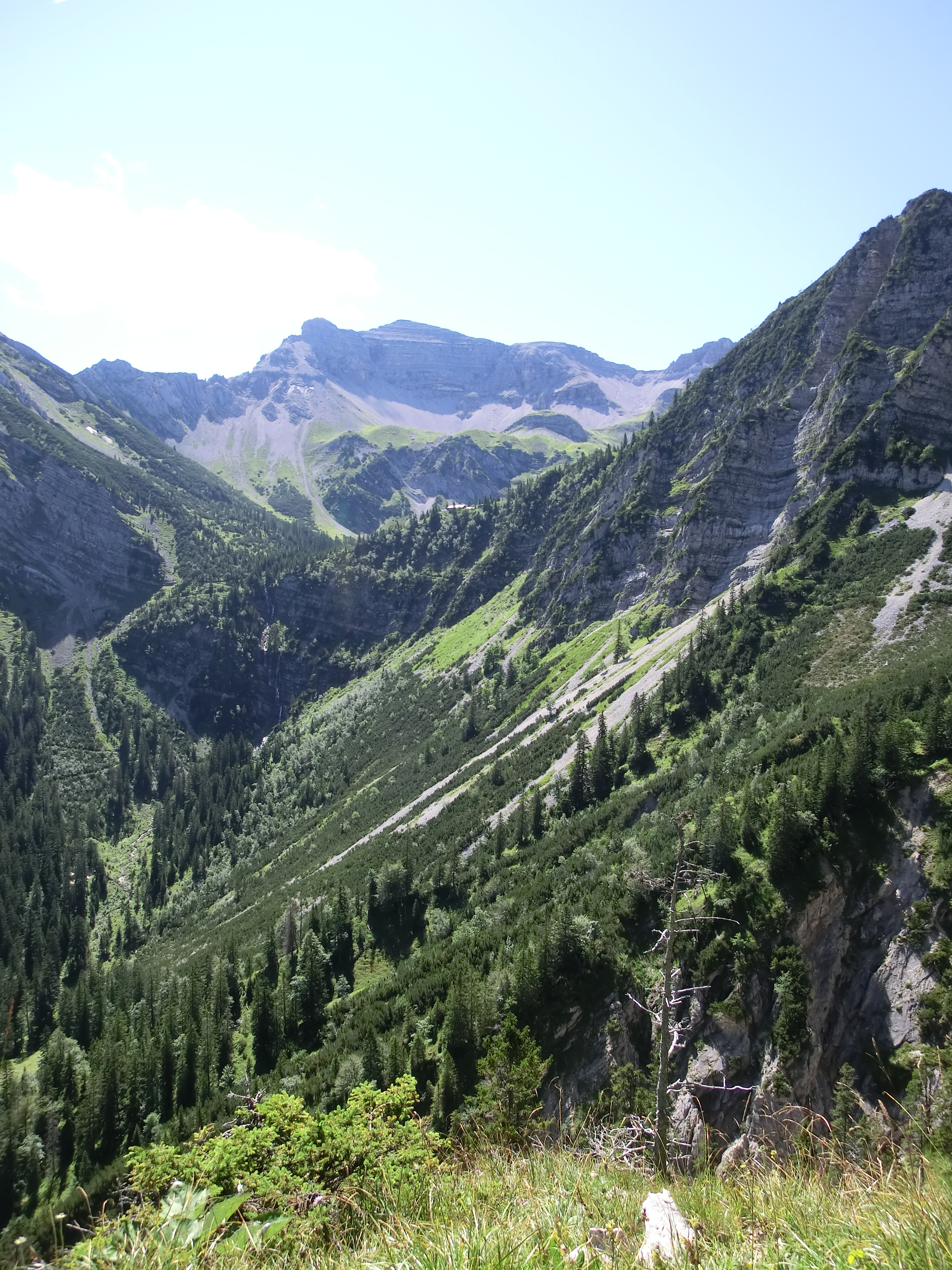
The smaller path was a delight at first with dramatic views of soaring peaks, rocky cliffs and cascading waterfalls opening out at every turn. However it wasn’t long before things started to get steeper, the path narrower and more exposed. “Only a short section like this surely”, I comforted myself, “…then things will be easier”. I was wrong.  The route became progressively more demanding and seemingly life-threatening with each unfolding view.

View along the Fischbach Tal towards the Soiernhaus and Soiernspitze

Some sections of the path had crumbled away completely. I gingerly negotiated these, trying hard to blank out the drops below and images of my corpse being discovered years later. Some parts of the route were protected by an old (although much welcome) rusty metal cable. Hanging on to this gave an illusion of modest security, though just how strong it was I wasn’t sure. Periodically the metal cable would come to an end just when it was most needed, leaving unprotected drops into an ever steepening abyss below. I was not enjoying my day of freedom quite so much now !

Confident that this could not continue, I picked my way along becoming increasingly aware of my own mortality; “All things must come to an end..”, I thought to myself somewhat ironically.”..soon I’ll be back on easier terrain”. I was by now about two-thirds of the way to my destination which I could see in front of me, tantalizingly close, at the end of the valley. The thought of a beer at the Soiernhaus kept me going. “Almost home and dry”, I imagined.

But it was not to be.  Around the next corner lay a particularly narrow and exposed section of path offering little or no protection. “All in the mind”, I tried to convince myself, but to no avail. I  warily tested out the tricky section of path three times (with a sandwich break for personal reflection  in between). No matter how hard I tried I just could not bring myself to negotiate this narrow section of path without being swamped by fears of vertigo and of tumbling unseen into the abyss below.

Stifling feelings of disappointment and personal failure I made my way back down the tortuous path and over the tricky sections again which I had previously negotiated.  To add insult to injury, I was passed on the way down by a cheerful Bavarian family with three small children who had just traversed the tricky sections of the path without so much as the blink of an eye. Had I been too long away from the mountains ?  Had becoming a Daddy and living in the flat lands made me finally lose my nerve and all head for heights ?  Should I be applying for membership of the nearest bowling club instead of wandering the mountains as a listless nervous wreck ?

Back at the Fischbachalm hut I consoled myself with a litre of elderflower juice (in preference to something stronger) and determined to find out more about the history of the “interesting” mountain route I had just discovered. As it turned out, it proved to be a most interesting history lesson indeed.

It transpired that the route was known as the “Lakaiensteig” or “Lackies” route. My online dictionary describes a lackie as meaning; “Someone who does things for you on command in fear that they will get a severe beating from their master”. A somewhat apt description it seems as the path had originally been created by order of King Ludwig II to get his servants up to the Soiernhaus by the most direct route possible, in time to get the table set for His Royal Highness. 

The principle interest of Ludwig was clearly not the welfare of the servants but instead to make sure that his dinner arrived on time and that a nice hot bath awaited his arrival at the Soiernhaus. Since the route was originally constructed in the 1800s, there has been considerable deterioration of the path. However, even then it must have been quite a challenge for heavily laden servants of the King to keep their balance on the precipitous slopes. In the meantime Ludwig would go the safe route with his royal entourage (travelling often at night and in a gold adorned sledge through the winter snows).

Not to be completely defeated, I opted to climb a lesser known ridge on the other side of the Fischbachalm as compensation for my defeated attempt on the Soiern Seen. I found a little used path threading its way up through alpine meadows and montane forest, climbing ever higher up the mountain slopes to the crest of the ridge above.  Although steep, the path did not have quite the same life threatening potential for me as the Lakaiensteig. Soon I was walking through a lost world of meadows high and looking down from high above on the valley of the Isar. 

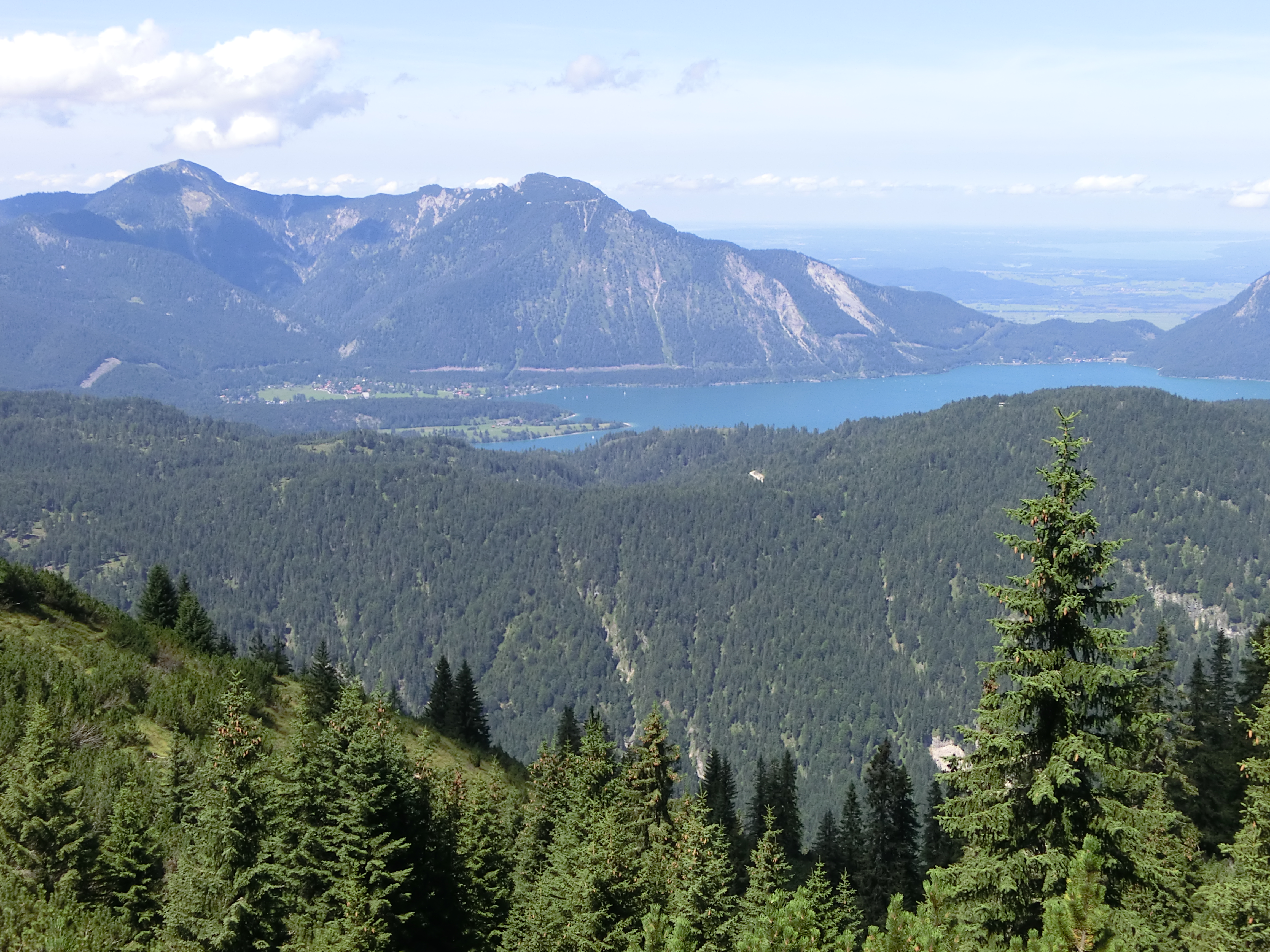
The Wallchensee, Herzogstand, Heimgarten and the Plains Beyond

I rounded a corner and the view unexpectedly opened up. To the North, the sun glinted off the turquoise waters of the Walchensee  surrounded by the distinctive peaks of Herzogstand and Heimgarten (also favourites of Ludwig II).  Far in the distance I could see the dusty plains towards Munich where the Alps abruptly ended and the flat lands began. Here, away from the more popular mountain routes, there was no sound and the air was still. A profound silence engulfed me, inviting me into the mountain’s secret heart.

I stood in awe of the unaccustomed silence for a short time before making my way back down the hill, passing the Fischbachalm hut before plunging deep into the forest again and down towards the valley settlements below.  Did I imagine it or could I already hear my children already screaming in the village below ?

The pleasures of the Soiern Seen would have to wait for another day. But I knew that, like Ludwig II,  I wouldn’t be following the Lakaiensteig next time (perhaps the time after that…).

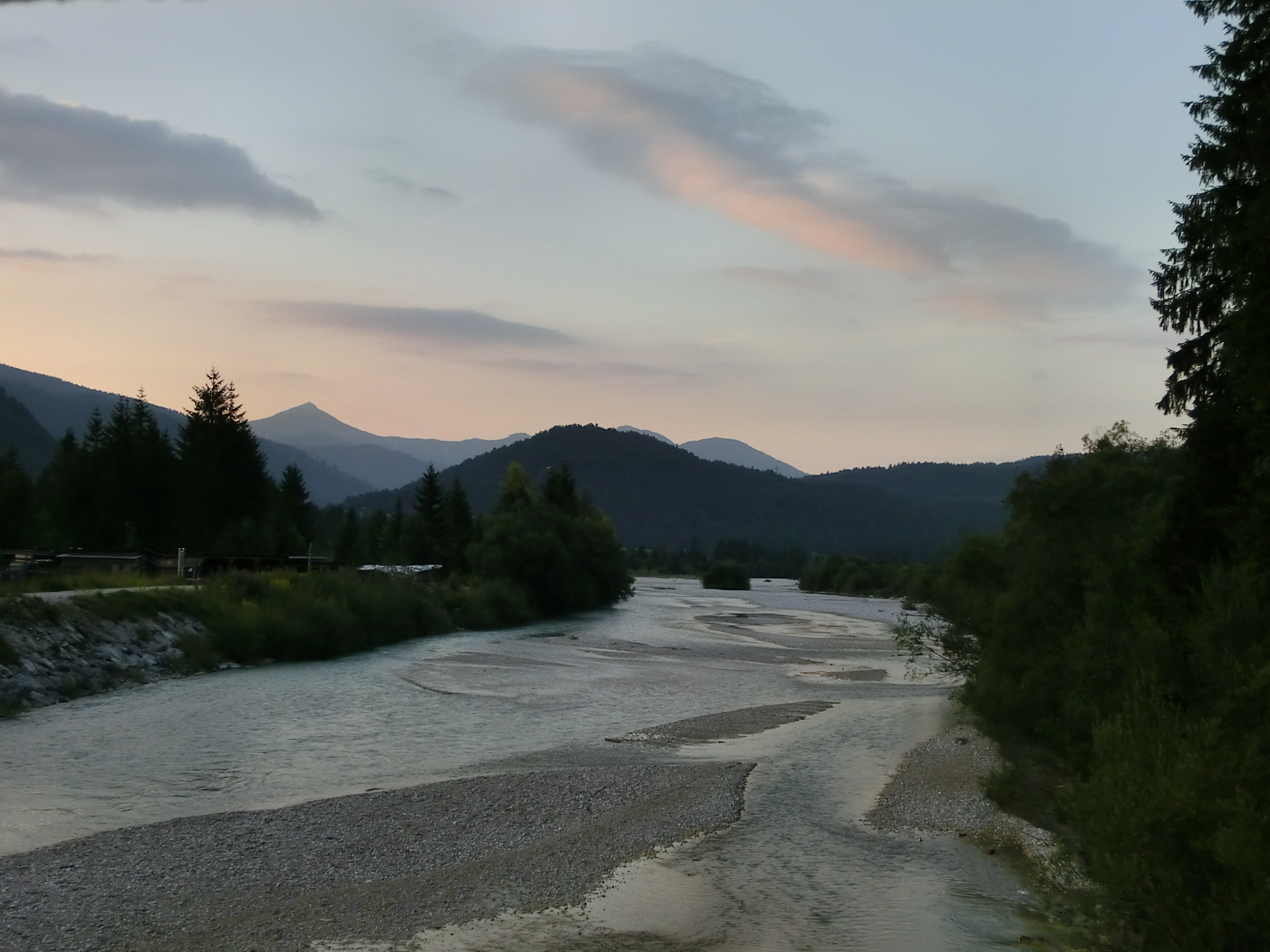
Evening light on the Isar

Posted in In Europe, Mountain Treks, Wild Places | Tagged , , , , , , , | 1 Comment

Mosel Less Travelled

ImageImage

Everyone knows about the Romantic Rhine; stereotypical landscapes of half timbered villages clambering up steep, vine bedecked slopes, crowned with dramatic medieval castles. These landscapes inspired a whole generation of 19th Century romantics, poets, travellers and artists including Byron and Turner. However the little sister of the Rhine, the Mosel, is perhaps less well known but equally rewarding to explore in its own right.

Tourist guides in English pay scant attention to the treasures of this meandering gem of a river which crosses the German border near Trier before looping majestically down to the confluence of the Rhine in Koblenz. Information on the Mosel for English speakers is usually confined to one of four main centres; Trier, Bernkastel-Kues, Cochem and Koblenz. Here one can find all the usual trappings of mass coach-tour tourism including crowds, souvenir shops and a suitable helping of kitsch.

However we wanted to discover the true heart of the Mosel and so over the last few months we have been seeking out smaller riverside villages, historical sites, ancient churches, wineries and  hidden treasures that give this area its own unique appeal. To complicate things we’ve also been taking our 2 small children in tow. However this allows us to slow down and to pay attention to some of the sights we would normally pass by or just merely take for granted.

By way of an example we stumbled across the picturesque village of Punderich, a riverside jewel where a maze of jumbled streets tumbles haphazardly towards the grassy banks of the river. We arrived just as the village was celebrating its annual wine festival. To our delight we found a cacophony of impromptu wine bars and stalls selling the Mosel’s distinctive slaty Rieslings and other local delicacies including the ubiquitous bratwurst.

Our children, Zoe and Kai, also enjoyed discovering makeshift flea markets set up by local school children to test out their business skills through selling toys, books and games to visitors (a right of passage for every young German it seems). It couldn’t last long however; my son must be the only 2 year old with a passion for church architecture. Before long he was running off with Martina in tow to witness yet another baroque gem of a church. I eventually tracked down Martina with the children in the church enjoying a moment of quiet contemplation in the otherwise empty nave, a rare moment of calm for 2 otherwise noisy youngsters who would otherwise be contributing to the decibel  level in the streets outside.

After sampling the local wine, cuisine (bratwurst and pommes!) and atmosphere at one of the many crowded stalls, we found a perfect exit from the village by crossing the old ferry that ploughs its way daily across the river to the other more peaceful bank opposite.

As our car bumped up the ramp on the opposite (and as yet) undiscovered side of the Mosel, we realised that this unplanned little exploration of a little known (to non-Germans) Mosel village would be the start of many such small adventures around this corner of Europe. Further adventures await…

Posted in Family, History & Culture, In Europe | Tagged , , , , , , | Leave a comment